Fear the Turtle: How Testudo Became the Face of the University of Maryland
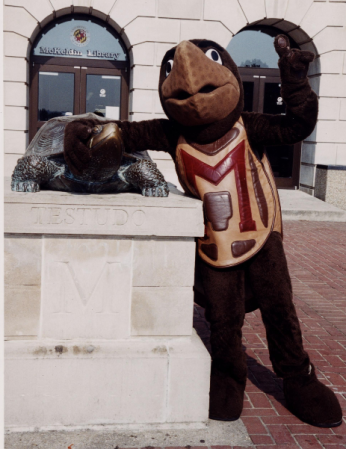
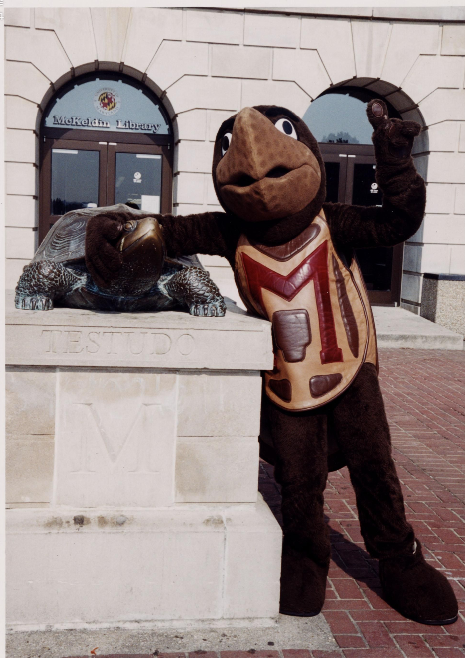
The reptilian face of the University of Maryland’s mascot, Testudo, is a common sight around campus for all students. Grinning in encouragement to freshmen or growling at rival sports teams, the diamondback terrapin has grown to become synonymous with College Park and the Maryland University system.
But for many years, the University of Maryland had no mascot at all. The first athletic mascots began to appear in the 1880s as good luck charms or objects of superstition, usually live animals or small children rather than costumed characters. 1 Yale’s Handsome Dan, introduced in 1889, is widely cited as the first college mascot, but the trend would take a few decades to catch on elsewhere.
In the early twentieth century, the undergraduate athletic teams of Maryland had gone by many names: they had been Aggies, Farmers, Ravens, and Old Liners. But had never united under a single mascot. When College Park (then called Maryland State College) was incorporated into the University of Maryland system in 1920, it became part of a new state entity still searching for its identity.
In 1932, Vice President Harry Clifton Byrd suggested that Maryland adopt the diamondback terrapin as a mascot. 2 Indigenous to the Chesapeake Bay, persistent, and temperamental, what the snapping turtle lacked in size, it made up for in fierceness. The main student newspaper had already been called The Diamondback for several years.
But the terrapin remained a mascot in name only, languishing without an official name or likeness.
Then, the graduating class of 1933 offered a gift to the school. They would donate a large terrapin statue for the campus as a memorial to their class and a formal symbol of the school’s mascot. It would be “our thank you to the institution.” 3
The senior class thought it was inappropriate for a large university to be without a mascot. One senior recalled his own deliberations on a school symbol: “Maryland had four great things: horses, beautiful women, terrapin soup, and race tracks.” Thankfully, the students settled on the terrapin because it was the most “original.” 4
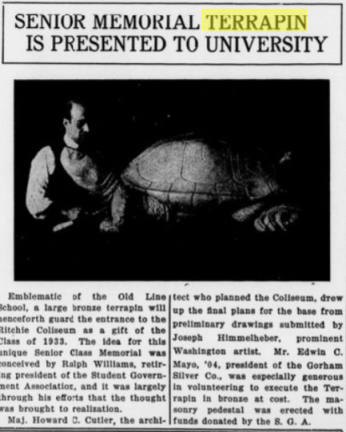
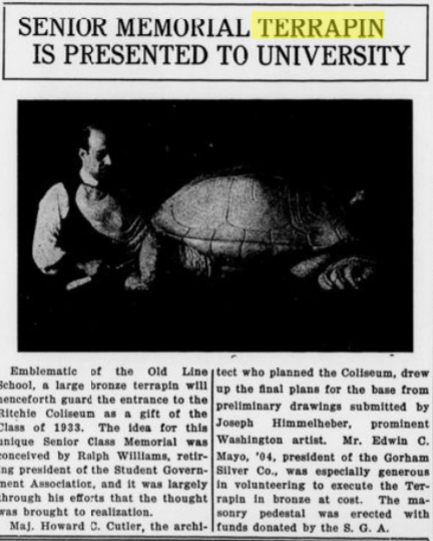
In partnership with Student Government, the 268 seniors had fundraised and saved amongst themselves. Led by Student Government president Ralph Williams, yearbook editor Harry Haslinger, and senior class president George Weber, the students scraped together $1,000 by holding prom on campus rather than in D.C., cancelling student magazine publications to save on expenses, and donating the proceeds of their 1932 yearbook. 5 The funds would be enough to cast a statue of a terrapin, granting the mascot an official place on the Maryland campus.
Vice President Byrd, who had grown up around the turtles in Crisfield, Maryland, wrote to the owner of a local seafood company to procure a model. He asked them to send “one big Diamondback Terrapin of Maryland variety, and not one of those that come from North Carolina.” 6
The terrapin that arrived from Crisfield was judged to be sufficiently imposing and was nicknamed “Archie” by the students. 7 The Student Government Association, Women’s Student Government Association, and the senior class president coordinated the terrapin’s travel and a sitting with an artist.
Ralph Williams boarded a train with Archie to Providence, Rhode Island in February, 1933. Archie sat to be sculpted by artist Aristide Cianfarani, and was then cast in bronze by Gorham Manufacturing Company. Edwin C. Mayo, a former quarterback, graduate of the Class of 1904, and president of Gorham Co. paid for the 300-pound statue himself. 8
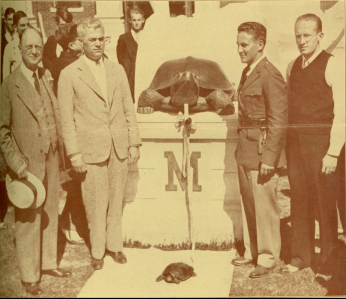
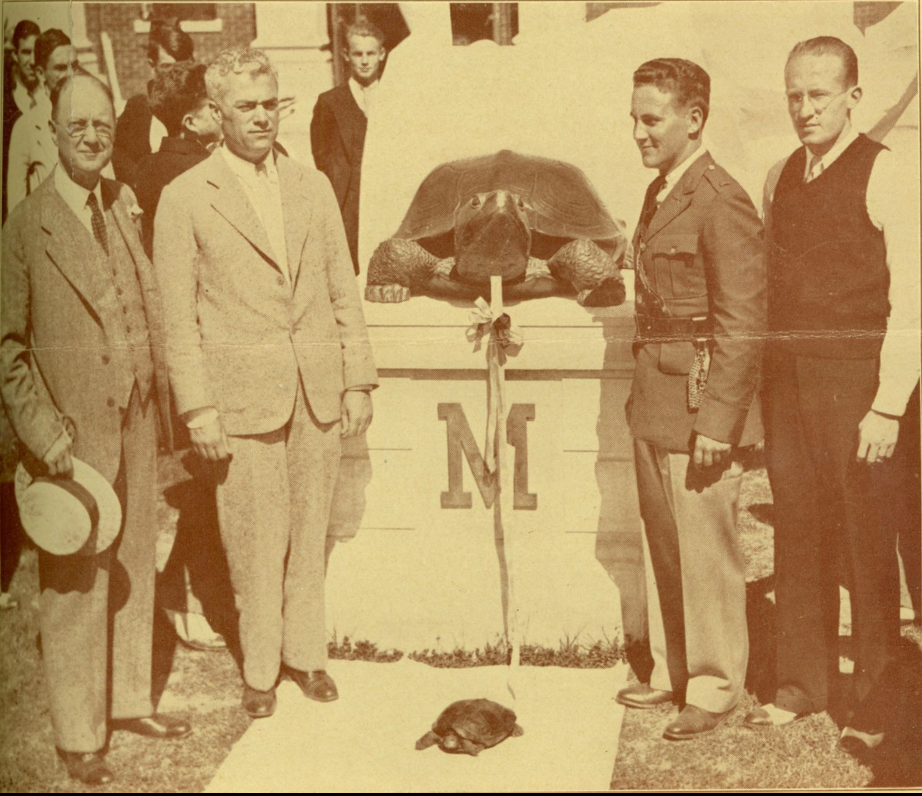
The dedication of the new Maryland mascot happened on June 2, 1933. Administrators chose Ritchie Stadium as its home, placing the pedestal in front of the arena. Archie himself revealed the statue, crawling forward and tugging a sheet attached to his shell with a ribbon. The bronze statue shone under the summer sun as Vice President Byrd announced the arrival of Maryland’s mascot: the terrapin. 9
Unfortunately, Archie died a few days after the unveiling of his likeness, likely from the heat and stress of the celebrations. 10 He was taxidermied and now resides in UMD’s archives.
No one is quite sure where the name Testudo came from. It is possibly derived from testudines, the scientific classification for all turtles. Other theories include inspiration from testudo gigantea, a species of giant tortoise endemic to the Seychelles, or a derivation from the Latin term for a Roman defensive tactic wherein soldiers used their shields to form a ‘shell’ around themselves. 11
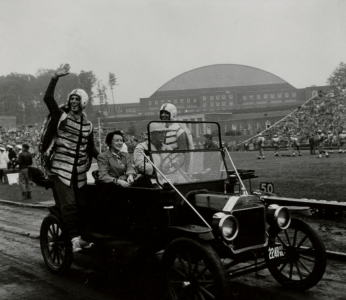
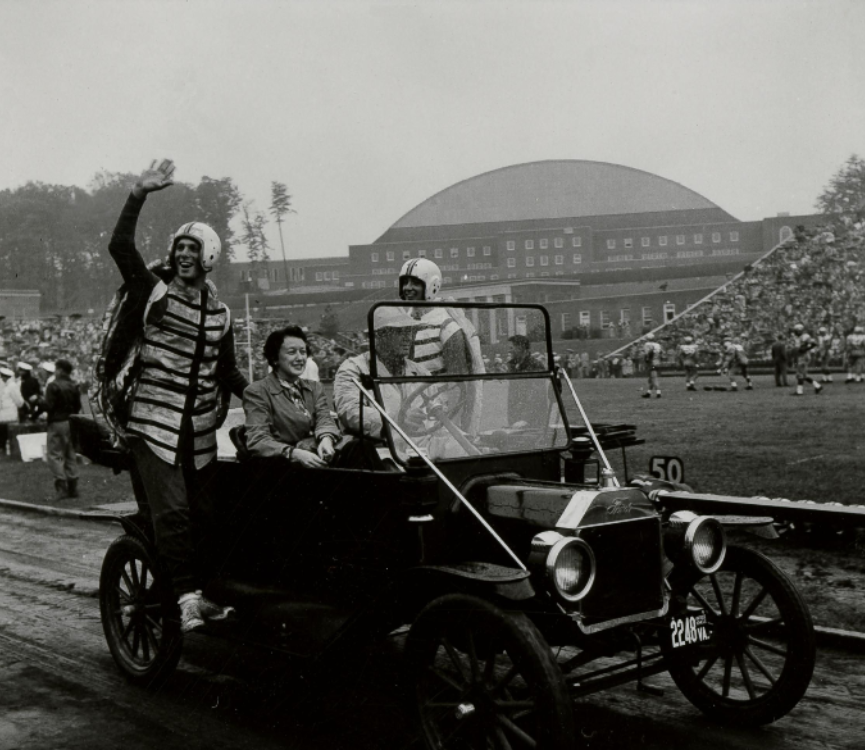
Both the name and the athletes’ new designation as Terrapins (often shortened to Terps), were quickly adopted. The campus newspapers were especially relieved, freed from having to cram Maryland Old Liners into their narrow column headlines. 12 Students began dressing up as Testudo to represent Maryland at sporting events: members of Zeta Beta Tau cobbled together the first mascot costumes in the 1950s, but were banned for “disorderly” conduct. 13 More advanced Testudos would follow.
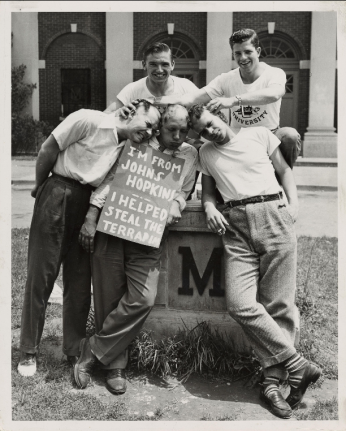
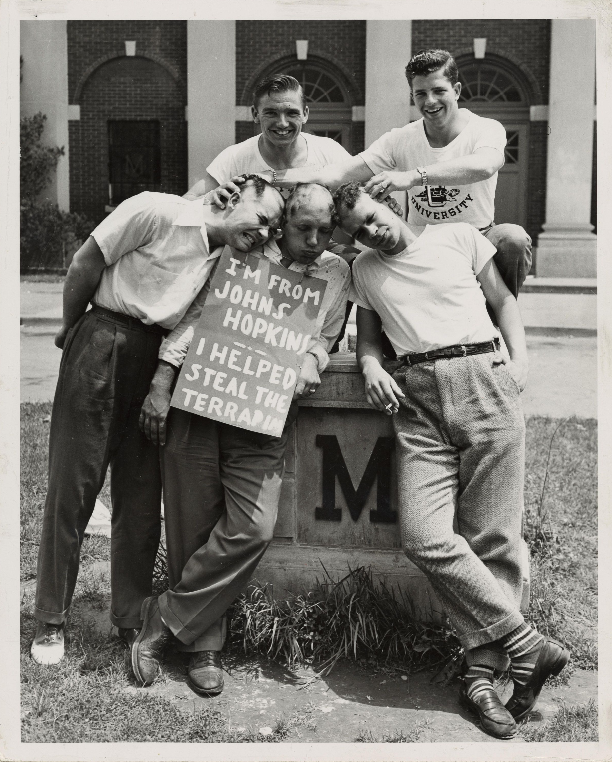
Almost immediately after his installation, Testudo became a target for rival schools. Over the next 15 years, Testudo became the victim of kidnappings by students from Georgetown, Johns Hopkins, George Washington University, and Loyola. Ritchie Stadium faced Route 1, and though the statue was several hundred pounds, if rival students could maneuver Testudo into a car, the highway provided a quick escape route.
The most well-known of these abductions happened in 1947, when Johns Hopkins students slipped onto the UMD campus before the two schools faced each other in a lacrosse championship. When the Maryland students realized Testudo had been taken (and his pedestal emblazoned with the letters JH), they followed the captors to a Johns Hopkins dorm. Braving the Hopkins students’ defenses of barbed wire, soap-slicked floors, and fire hoses, the Maryland students raided the building. More than 200 Baltimore police officers were called to the scene, and peace only returned once the dean of Johns Hopkins promised to locate and return Testudo (whom the Hopkins students had buried for safekeeping). 14
As kidnappings and mischief piled up, university authorities decided to move Testudo to storage, but UMD still needed its mascot. The solution? Affix Testudo to his pedestal with steel bars, fill him with concrete, and move him to a new location. Now over 1,000 pounds and further from the road at McKeldin Library, he has proved significantly more difficult to abduct.
Another tradition UMD students know well is to rub Testudo’s nose for good luck before exams—a practice that has existed since his installation in 1933. But in the 1990s, something else began happening on campus. Small “offerings” appeared on and around the Testudo statue before exams: students had left small gifts in exchange for high marks.
While the first offerings were drinks, small food items, and a trinket or two, over the years the gifts escalated. Informal adolescent competition inspired students to bring stranger and more outrageous items to Testudo: traffic cones, lawn signs, balloons, life-size cutouts of the Pope. 15 Towards the end of exams, there were sometimes so many offerings that Testudo disappeared beneath them.
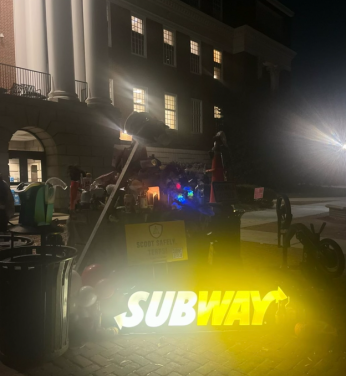
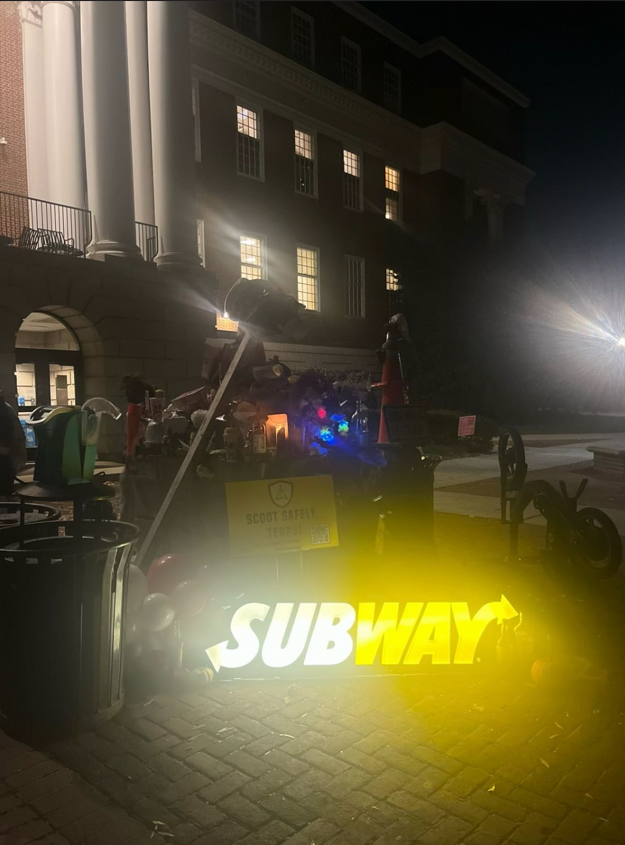
After a while, the tradition spiraled past good fun and into potentially dangerous territory. In 2013, something on the offering pile caused a fire. 16 Some students were also dabbling in potential theft and misdemeanors: one student left a toilet as an offering; another brought a Subway store sign.
Finally, UMD administrators got involved. A police officer was stationed nearby to monitor any ill-gotten offerings. Instead of bringing the most humorously improbable gift possible, students were encouraged to bring Testudo nonperishable food items, which would then be collected for the UMD Campus Pantry. 17 Some students were not amused at administrators spoiling their fun, but since the change, Testudo has been quieter during exam season.
Even though the Class of 1933’s gift was a statue, the University of Maryland is still learning things about Testudo. In 2018, analysis of Archie, the original terrapin and model for Testudo, determined that he was actually a she. 18 It is likely that students and administrators assumed the large turtle was male simply because of its size, following the tendency to associate power, ferocity, and aggression with male mascots.
In light of the news, perhaps the “Testudinette” that appeared in yearbooks and student newspapers from the 1950s to 1980s should have been UMD’s real mascot all along! 19
Footnotes
- 1
Marzick, Jeff. “The History of Team Mascots.” The Culture Crush, November 20, 2019. https://www.theculturecrush.com/feature/mascots. The shift from mascots portrayed by live animals or humans to fully-costumed characters had much to do with advances in American puppetry in the mid-1900s, especially Jim Henson’s development of the Muppets. Testudo’s first full-costume appearances began in the 1960s and 70s but did not mature into the modern character until the 1980s.
- 2
Maryland Athletics. “Testudo: Tale of the Top Shell.” University of Maryland Official Athletic Site, May 16, 2011. https://web.archive.org/web/20110516033155/http:/www.umterps.com/trads/md-m-fb-mas.html.
- 3
Hawkins, Ronald. “Testudo, the Original Terrapin.” Prince George’s Journal, October 24, 1983. George Weber Collection, Box 1, Folder 2. University of Maryland Archives, College Park, MD.
- 4
Hawkins, Ronald. “Testudo, the Original Terrapin.” Prince George’s Journal, October 24, 1983. George Weber Collection, Box 1, Folder 2. University of Maryland Archives, College Park, MD.
- 5
UMD Archives. “Testudo.” UMD a to Z: Mac to Millenium, University of Maryland, September 29, 2009. https://web.archive.org/web/20100609170833/http:/www.lib.umd.edu/univarchives/macmil/testudo.html.
- 6
UMD Archives. “Happy Birthday, Testudo!” Terrapin Tales, June 2, 2018. https://umdarchives.wordpress.com/2018/06/02/happy-birthday-testudo/.
- 7
Maryland Today Staff. “Standing the Testudo of Time.” Maryland Today, January 26, 2024. https://today.umd.edu/standing-the-testudo-of-time.
- 8
Maryland Athletics. “Testudo: Tale of the Top Shell.” University of Maryland Official Athletic Site, May 16, 2011. https://web.archive.org/web/20110516033155/http:/www.umterps.com/trads/md-m-fb-mas.html.
- 9
This pronouncement was quickly and happily adopted by students and athletes, but the terrapin’s status as UMD’s mascot remained unofficial. Testudo was formally named UMD’s mascot in 1983 at the most fitting of events: at the 50-year reunion of the class of 1933.
- 10
Maryland Today Staff. “Standing the Testudo of Time.” Maryland Today, January 26, 2024. https://today.umd.edu/standing-the-testudo-of-time.
- 11
Maryland Athletics. “Testudo: Tale of the Top Shell.” University of Maryland Official Athletic Site, May 16, 2011. https://web.archive.org/web/20110516033155/http:/www.umterps.com/trads/md-m-fb-mas.html.
- 12
Maryland Athletics. “Testudo: Tale of the Top Shell.” University of Maryland Official Athletic Site, May 16, 2011. https://web.archive.org/web/20110516033155/http:/www.umterps.com/trads/md-m-fb-mas.html.
- 13
Maryland Today Staff. “Standing the Testudo of Time.” Maryland Today, January 26, 2024. https://today.umd.edu/standing-the-testudo-of-time.
- 14
UMD Archives. “Testudo.” UMD a to Z: Mac to Millenium, University of Maryland, September 29, 2009. https://web.archive.org/web/20100609170833/http:/www.lib.umd.edu/univarchives/macmil/testudo.html.
- 15
Maryland Today Staff. “Standing the Testudo of Time.” Maryland Today, January 26, 2024. https://today.umd.edu/standing-the-testudo-of-time.
- 16
Maryland Today Staff. “Standing the Testudo of Time.” Maryland Today, January 26, 2024. https://today.umd.edu/standing-the-testudo-of-time.
- 17
Maryland Today Staff. “Standing the Testudo of Time.” Maryland Today, January 26, 2024. https://today.umd.edu/standing-the-testudo-of-time.
- 18
Ghosh, Eleena. “Testudo’s Womanhood: A Case Study in Gender Norms.” Terrapin Tales, January 29, 2024. https://umdarchives.wordpress.com/2024/01/29/testudos-womanhood-a-case-study-in-gender-norms/.
- 19
Ghosh, Eleena. “Testudo’s Womanhood: A Case Study in Gender Norms.” Terrapin Tales, January 29, 2024. https://umdarchives.wordpress.com/2024/01/29/testudos-womanhood-a-case-study-in-gender-norms/.


![Sketch of the mythical fuan by Pearson Scott Foresman. [Source: Wikipedia]](/sites/default/files/styles/crop_320x320/public/2023-10/Goatman_Wikipedia_Faun_2_%28PSF%29.png?h=64a074ff&itok=C9Qh-PE1)