The Cinema Follies Fire and What It Revealed About Washington
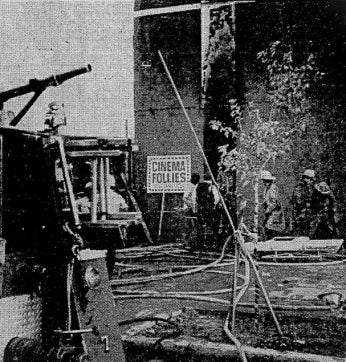
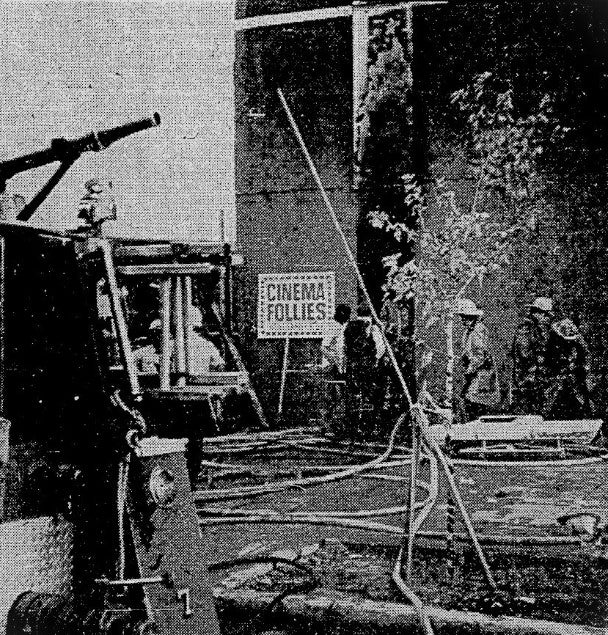
It was a cool evening on October 24, 1977. The Cinema Follies Film Club was cleaning up from its second anniversary party. It was a Federal holiday – Veterans Day observed – so the club was more crowded than it would be on a typical Monday, but still relatively quiet. Martin Crowetz, who worked maintenance for the club, was shampooing the carpet in the lobby when a popping sound from the corner of the room broke his concentration. He hadn’t known, but the chemicals he’d used were flammable. 1 Whether it was the gas heater or a spark from the rug shampooer, the carpet had caught fire. And it was spreading quickly.
Crowetz emptied two fire extinguishers. Bill Oates, the club manager, soaked tablecloths, hoping they would smother the growing blaze. 2 But the fire was spreading across the lobby. Someone went to call for help, but when they picked up the receiver, they were met with silence. The phones weren’t working. So Oates ran to his car and sped to a nearby fire station for help. 3
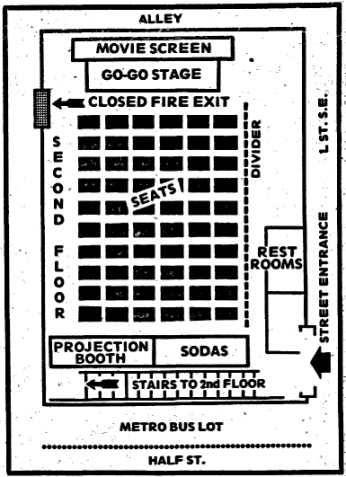
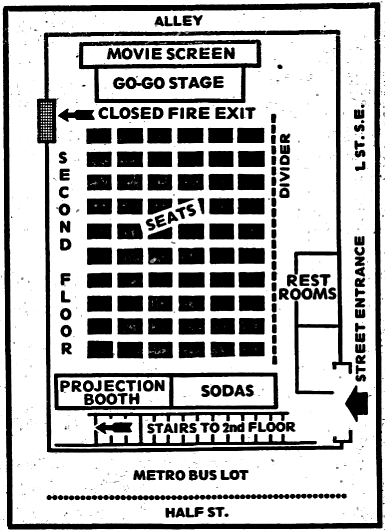
By then, flames had started “shooting up the stairwell” to the second floor. 4 Upstairs, in the 75-seat theater, a group of fourteen men were watching a movie. Someone commented on the growing haze visible in the projector light, and “about a minute later someone said there was fire.” 5 Initially, the patrons were orderly, and went to leave via the stairs, but the tremendous heat forced them back up towards the screen. 6 Thankfully, to the left, there was an emergency exit. 7
Technically, the door at the back of the theater was not an emergency exit. But it was an access door to the roof, and it was the only other way out of the theater. 8 They reached the door, pushed and pulled – it remained firmly shut. Fumbling around in the dark, one of the men grabbed hold of something metal. It was solid, and fit in the palm of his hand. A moment later, he came to the crushing realization: it was a padlock, “the type you would put a key in from the bottom to open.” 9 His hands swept the floor frantically, but there was no key.
The men were trapped, and they didn’t know if help was coming. Some fought the locked door. Others returned to the orange and black theater seats in resignation. 10 The man who’d discovered the lock laid down, hoping it would be even the slightest bit easier to breathe from the floor, as smoke filled the theater. As the voices around him fell silent, he thought back to “less than a month ago” when he’d noticed that lock and asked himself, “Why have they done that?” 11
Firefighters arrived on the scene, and entered the club through the front door, where they were met with “a sheet of flame from the lobby and stairway.” 12 So, they made their way to the gravel-topped roof, where they broke through the locked door. Thick smoke billowed from the theater, where the “victims of the blaze were found huddled in a heap” at their feet. 13 Firefighters “hauled bodies – some alive and some dead – out onto the roof of the movie house.” 14 A Catholic priest was “hoisted to the roof by a fire lift [and] administered last rites to the victims.” 15
Three men were declared dead at the scene. 16 The rest of the victims were brought to nearby hospitals, where six more would pass from smoke inhalation. 17 Close behind was the press, clamoring for information about the victims. But there wasn’t much to give. Most of the men didn’t have identification on them. A few of them did, but it wasn’t reliable; it was common practice for people to carry false identification with them to establishments like the Cinema Follies Club.
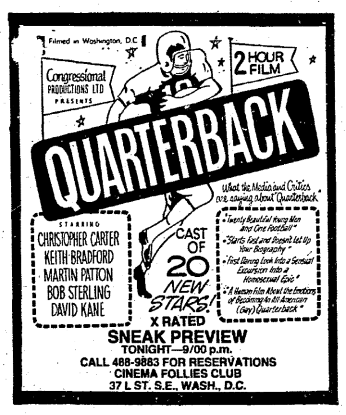
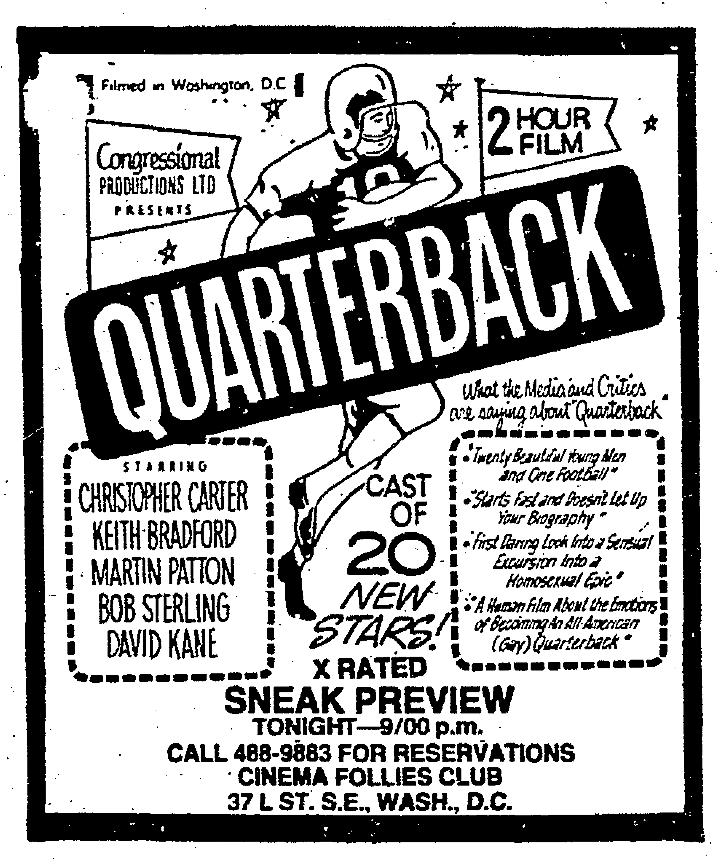
Follies was known to the public as “a film club for homosexuals.” 18 And yes, the club’s main draw were daily screenings of x-rated all-male movies. But it also had male burlesque dancers, regular opportunities to meet actors from the films that were shown, and even contests. A letter from the management teased “another Roman ‘O.’” An event that included “stars on stage – champagne – towels – champagne breakfast – noise makers – hot dancers and more, more, more.” 19 Follies could also attribute some of its popularity to its reputation as a casual, anonymous meeting place. And, evidently, the club was quite popular. It boasted a very “broad-based membership [of] nearly 22,000 members.” 20
It had only opened two years before the fire, in 1975. During the 70s, DC saw a substantial growth spurt in businesses that catered to the queer community – ranging from bookstores, to bars, to theaters like Follies. The Washington Star regarded this as the culmination of the unique social and legal climate Washington had been slowly developing over the previous twenty years. 21
The '70s produced fundamental changes that brought increased visibility to the city’s queer community. In 1972, LGBTQ activists were successful in getting sexual orientation included under the District’s Title 34, which was “model human rights legislation” preventing discrimination. 22 Three years later, in 1975, DC's Metropolitan Police discontinued patrols by it’s Perversion Squad the name given to plainclothes officers dispatched through parts of the city where the LGBTQ community gathered. 23
But the most significant change came in the summer of 1975. The U.S. Civil Service Commission revised employment guidelines and determined that homosexuality could no longer be used as grounds for dismissal from a federal job. Years of activism had seemingly liberated the heart of the ‘Lavender Scare,’ and created – as The Washington Star put it - “the Emerald City of live-and-let-live tolerance for homosexuals.” 24
But this tolerance was nuanced. As Joe Totten, a staffer for the Gay Rights National Lobby told reporters days after the Cinema Follies tragedy, “We have gained this acceptance, primarily, by keeping discreet and middle-of-the-road politics, behavior and dress – so that we don’t appear to be threatening straight society.” 25
Laws that legitimized police harassment of the gay community – like those regarding sodomy and pornography – were still on the books. And they were used to justify entrapment operations, and the frequent raids conducted on gay businesses. 26 Popularity within the community often meant a business would be subjected to police harassment. Follies was raided twice in the span of three months in 1976, hence why many of its customers had illegitimate ID – it was a precaution, in case the club was raided. 27 Although arrests made during these raids rarely went to trial or resulted in a conviction, they were still significant. Many customers of queer establishments were closeted, and their main fear was that their “often hidden sexual preferences might become public knowledge.” 28
Thus, many gay businesses sought to operate with a degree of discretion. Like Cinema Follies, they frequently took old warehouses and converted them into social spaces. Acquiring and renovating the space was done for cheap. Nightlife spaces that catered to the queer community were still relatively limited, so those that were available, were often “overused and over-crowded.” 29
Follies exemplified this. The club’s official hours were from noon to 5 a.m., but many people reported that it was effectively open twenty-four hours a day. And Paul Kuntzler, founder of the Gay Activists Alliance, said he’d seen as many as 300 people in the 75-seat theater. 30
Establishments like Follies were, thus, very frequently in violation of fire codes. Often, they didn’t know. But if they did, they rarely had to correct it. The fire department lacked the authority to enforce fire codes itself. Violations were reported to the Department of Housing and Community Development, which would make a separate decision about whether there was a violation. 31 That’s if a business was regularly inspected in the first place. A “survey of fire records indicated that, at the time of the Follies fire, most gay establishments had not been given the ‘thorough’ inspection in several years.” 32
In the weeks following the Cinema Follies tragedy, Washingtonians – gay and straight alike – tried to come to grips with what had happened and what it revealed about life in the District. Some, especially within the gay community, felt called to action.
Queer activists like Paul Kuntzler became outspoken advocates for improved fire safety. The Gay Activists Alliance (GAA) adopted a project with the following demands: That the fire department inspect all gay-oriented public establishments that had not been inspected within the past month, that a committee (composed of GAA members, fire department officials, and other community representatives) be established, that the committee establish an interim fire code for gay-oriented businesses, and that a collective effort be made to update the DC fire code. 33
Although the GAA’s project was not adopted verbatim, the activism - and media attention that it garnered - produced governmental action. The District gave fire officials definitive authority over fire code regulations, and the capacity to temporarily close down establishments "where there was overcrowding or other fire hazards." 34 In 1979, a fire marshal told Star reporters that "the possibility of another Cinema Follies is substantially less today," as a result of the policy changes. 35
The city’s mainstream newspapers, the Washington Star and the Washington Post, reported extensively on the fire victims, most of whom contradicted the expectations that many straight readers had.
Among those who died was the chief legislative assistant for a South Carolina Representative. One was an Army major, and had recently returned from a tour of duty in Korea. And a church official, who served the Church of the Brethren for twenty years as a pastor. 36 They represented a “typical cross-section of the community at large, including professionals in highly visible positions, military personnel,” and to the surprise of many, “husbands, and fathers.” 37
This, of course, came as no surprise to the queer community. Washington’s LGBTQ newspaper, The Blade, found comfort in the idea that the tragedy "forced many people to rethink their stereotypes of gays – and in doing so, recognize these men as members of their families, their friends, their co-workers and their neighbors." 38
Greater recognition and acceptance would take time to materialize. But the Follies fire, and the city's response to it, was an identifiable marker that progress was developing.
Following the fire, the Star published a four-part series about “why Washington [was] known as the most accepting city in the nation for gays.” 39 It explored a vibrant community that was guarded out of necessity but, at the same time, was deeply ingrained in almost all areas of Washington life. As Joe Totten told a Star reporter, “Sometimes I think it would be fun if we all turned purple one day. Then all the unsuspecting straights out there would see how well we’ve worked into the system.” 40
Footnotes
- 1
Laura A. Kiernan, “Flames Were Shooting Up Stairwell, Custodian Says: Frantic Effort to Halt Fire Described by Caretaker,” Washington Post, October 27, 1977.
- 2
Kiernan, “Flames Were Shooting Up Stairwell, Custodian Says.”
- 3
Kiernan, “Flames Were Shooting Up Stairwell, Custodian Says.”
- 4
Kiernan, “Flames Were Shooting Up Stairwell, Custodian Says.”
- 5
“Fire Survivor: ‘…I Cannot Explain the Rage I Felt…,’” Washington Post, October 26, 1977.
- 6
“Fire Survivor: ‘…I Cannot Explain the Rage I Felt….’” Washington Post.
- 7
Lynn Dunson, “Fire Officials Renew Attack on District Building Code,” Washington Star, October 26, 1977, p. 19.
- 8
Dunson, “Fire Officials Renew Attack on District Building Code.”
- 9
“Fire Survivor: ‘…I Cannot Explain the Rage I Felt….’” Washington Post.
- 10
Kiernan, “Flames Were Shooting Up Stairwell, Custodian Says.”
- 11
“Fire Survivor: ‘…I Cannot Explain the Rage I Felt….’” Washington Post.
- 12
Thomas Lyles, “Negligence Investigated as Fire at SE Club for Homosexuals Kills 6,” Washington Star, October 25, 1977, p.8.
- 13
Dunson, “Fire Officials Renew Attack on District Building Code."
- 14
"Police Identify Last Two Victims of The Cinema Follies Fire,” Washington Star, October 28, 1977, p. 19.
- 15
Walker, Kenneth, “5 Other Victims in Critical Shape at Hospital," Washington Star, October 25, 1977, p. A-8.
- 16
Kenneth Walker, “5 Other Victims in Critical Shape at Hospitals,” Washington Star, October 25, 1977, p. 3.
- 17
Dunson, “Fire Officials Renew Attack on District Building Code.”
- 18
Dunson, “Fire Officials Renew Attack on District Building Code.”
- 19
Amber Bailey, “Historic American Buildings Survey: 37 L ST, SE (Cinema Follies),” The National Parks Service, 2016, HABS Survey Cinema Follies DC.
- 20
Lyles, “Negligence Investigated as Fire at SE Club for Homosexuals Kills 6.”
- 21
Donia Mills, “Washington Called the Gay Capital,” Washington Star, October 30, 1977, p. 1.
- 22
Donia Mills, “Gay Political Experience in Washington,” Washington Star, October 31, 1977, p. A-10.
- 23
Mills, “Gay Political Experience in Washington,” Washington Star, October 31, 1977, p. A-10.
- 24
Mills, “Washington Called the Gay Capital.”
- 25
Mills, “Washington Called the Gay Capital.”
- 26
Mills, “Washington Called the Gay Capital.”
- 27
Bailey, “Historic American Buildings Survey.”
- 28
Phil McCombs, “Fire Victims’ Families Doubly Shocked – Relatives, Friends of Blaze Victims Have Added Burden,” Washington Post, October 27, 1977.
- 29
Lyles, “Negligence Investigated as Fire at SE Club for Homosexuals Kills 6.”
- 30
Lyles, “Negligence Investigated as Fire at SE Club for Homosexuals Kills 6.”
- 31
Lou Romano, “Follies Fire Controversy Continues,” Blade (Washington, D.C.), January 1978, The Blade, January 1978 | Dig DC: The People's Archive Digital Repository at DC Public Library.
- 32
Romano, “Follies Fire Controversy Continues.”
- 33
Mayo Lee, “Letters to The Editor: The Cinema Follies Fire,” Washington Post, November 1, 1977.
- 34
"Cinema Follies Fatal Fire Trial Gets Underway," Washington Star, January 8, 1979, p. A-1.
- 35
"Cinema Follies Fatal Fire Trial Gets Underway," Washington Star, January 8, 1979, p. A-2.
- 36
McCombs, “Fire Victims’ Families Doubly Shocked."
- 37
Galen Ross and Lou Romano, “Fire Stirs Strong Community Reaction,” Blade (Washington, D.C.), November 1977, The Blade, November 1977 | Dig DC: The People's Archive Digital Repository at DC Public Library.
- 38
Bailey, “Historic American Buildings Survey.”
- 39
Mills, “Washington Called the Gay Capital.”
- 40
Mills, “Washington Called the Gay Capital.”