Frederick Douglass’s Son Charles Pioneered Black Baseball in D.C.
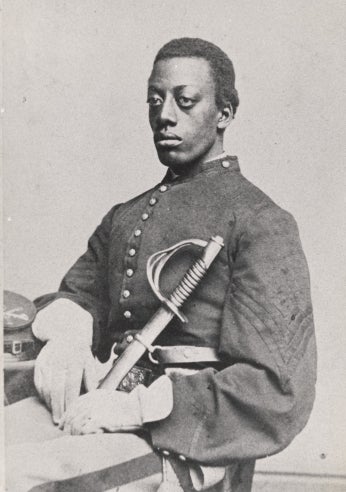
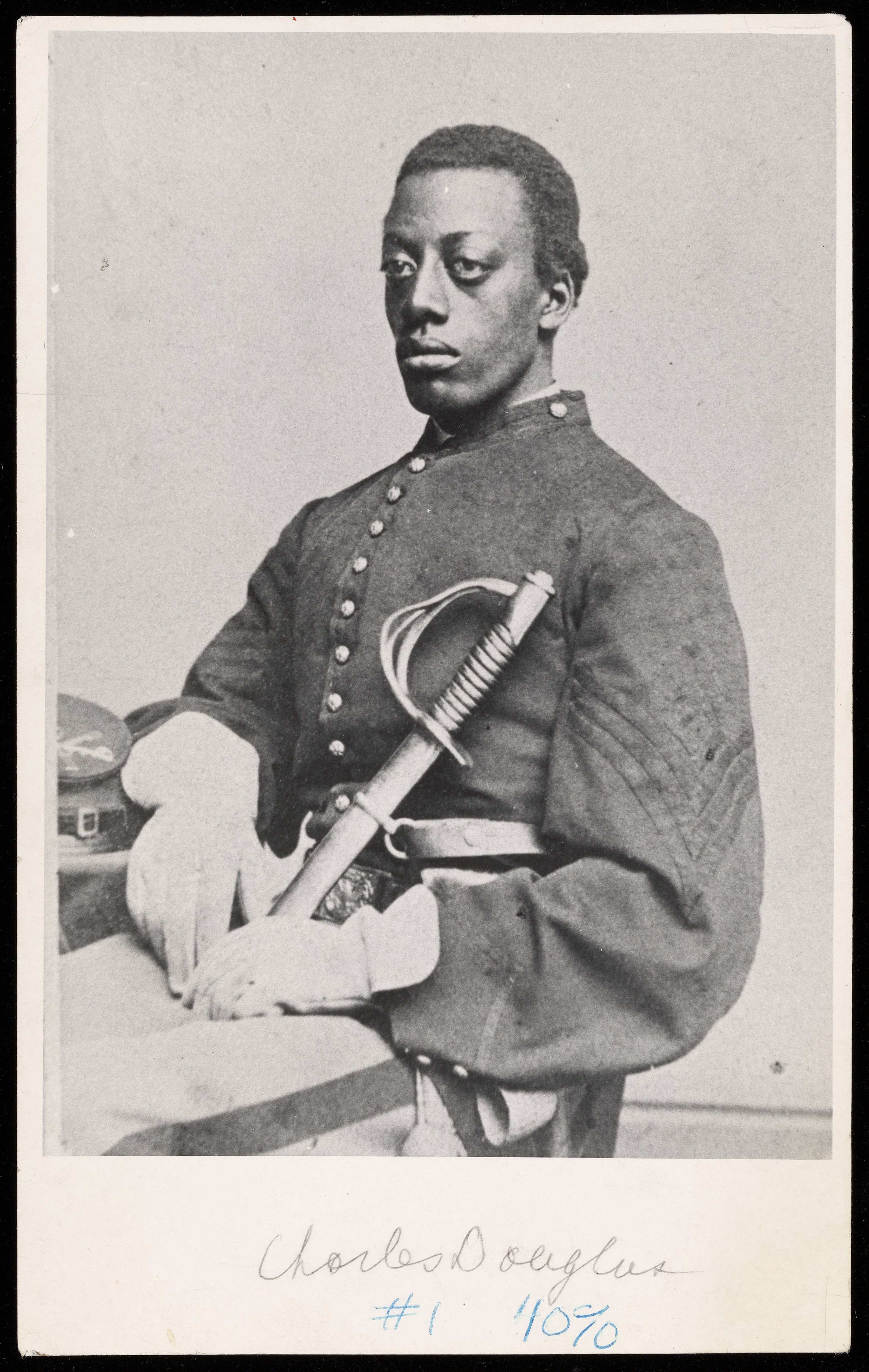
Washington, DC, has a rich baseball history stretching back over 160 years. But long before the Nationals and Senators of Major League Baseball and the Negro leagues’ Homestead Grays won over legions of fans, famed abolitionist Frederick Douglass’s son Charles paved the way for black ballplayers in the District.
In the late 1860s, the younger Douglass helped organize and played for the Alert and Mutual Base Ball Clubs, two of DC’s first all-black teams. 1 The clubs’ success mirrored black Washingtonians’ wider fight for equality in the face of discrimination and simmering racial tensions during the Reconstruction era.
In the immediate aftermath of the Civil War, baseball exploded in popularity across the country, especially among returning veterans. By 1869, the New York Times estimated there were more than 1,000 active clubs in the U.S. (other papers put the total closer to 2,000) and over 200,000 fans flocked to games annually. 2
While the early amateur leagues lacked formal segregation policies, black players were still largely excluded from white rosters. Wary of aggravating Southern teams, early baseball promoters like Henry Chadwick cast the “national game” as inherently white in nature to help facilitate postwar reconciliation between North and South. 3
“Both games [baseball and cricket] rest, first, upon the desire of the Anglo-Saxon (we do not say Caucasian, or Aryan, because we like to be exact) to arm himself with a stick and drive a small round body with it,” Chadwick wrote in his Base Ball Manual, for 1871. 4 “And secondly, upon the desire of any other Anglo-Saxon who happens to be in the way to stop this body, to deprive the other of his stick, and ‘bat’ himself.”
Chadwick and other white writers’ efforts did not stop black Americans from playing and excelling at the new game en masse. With its massive influx of black residents during the war, Washington was primed to become an early center of black baseball. By 1867 38,663 of the city’s 126,990 residents were black, up from 14,316 in 1860 and a far higher percentage than northern cities where baseball was also taking off. 5
Among the new black Washingtonians was Charles Remond Douglass, Frederick Douglass’s third and youngest son who served with the 54th Massachusetts Infantry Regiment during the war but did not see action due to illness. Charles, still in his early twenties, settled east of the Anacostia River, in what is today’s Barry Farm–Hillsdale neighborhood, while he clerked at the Freedmen’s Bureau from 1867-1869. 6
Like many other federal employees, Douglass took up baseball, in his case joining the all-black Alert Base Ball Club. 7 DC was home to dozens of teams at the time which ranged widely in quality, from the more competitive-minded Washington Nationals (no direct connection to the current franchise) to the Census Bureau’s “Shoo-Fly” and “Don’t Bodder Me” squads and the “Typos’ Base Ball Club” fielded by the Government Printing Office. 8
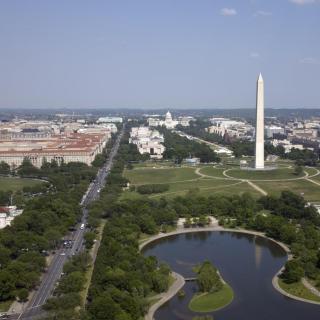
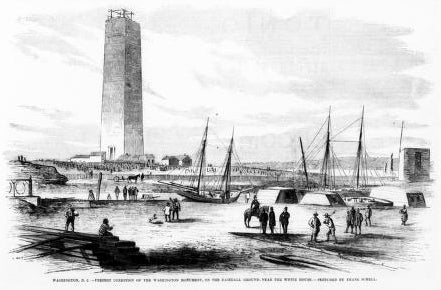
The epicenter of DC baseball in the late 1860s was the “White Lot,” a patch of grassy fields between the White House and the Washington Canal (today’s Constitution Avenue) that’s now occupied by the Ellipse. 9 Back then white fences surrounded the lot, giving it its name, and black and white teams alike used it for home games, which were occasionally attended by the president.
“The way the balls fly in every direction is enough to remind a veteran of the army of the time when he found himself like the ‘six hundred’ in the Crimea, who had ‘balls to the right of them, balls to the left of them,’” the New York Clipper, a newspaper known for its baseball coverage, said of the chaotic ballfield in 1866. 10
Charles, who had missed out on wartime heroics and struggled to forge his own identity outside the legacy of his nationally-renowned father, found that baseball could be his own vehicle for championing black excellence.
“Inherent in the quest of black baseball clubs to find success (borne out in prestige, financial stability, land use, and games against white clubs) were ideas about autonomy, equality, and opportunity—the same considerations driving many black Washingtonians to build schools and fight for equal access to federal jobs,” sports historian Ryan Swanson writes in his 2014 book When Baseball Went White: Reconstruction, Reconciliation, and Dreams of a National Pastime. 11 “Taking cues from his father, Douglass never suggested that the integration of baseball at all costs was his goal. Instead, Douglass focused his attention on building successful and respected black-led clubs.”
In July 1867, the Alerts traveled to Philadelphia to square off against the Pythian Base Ball Club, another prominent black team run by civil rights activist Octavius Catto. Playing in front of “quite a concourse of spectators,” which included Frederick Douglass, the Alerts defeated the Pythians 21-16 after the umpire called the game due to a “heavy shower of rain” in the fifth inning. 12 “The hitting and fielding of both clubs were very good,” the NewYork Clipper reported. 13
With the victory the Alerts could claim to be black baseball’s unofficial champions, a title that was short-lived after the Pythians traveled to DC several weeks later and had their revenge, to Charles’s chagrin. 14 Despite the drama of the well-attended Alerts-Pythians series, the games received virtually no coverage from the DC press.
After staff reductions forced him out of the Freedmen’s Bureau in the spring of 1869, Douglass found work at the Treasury Department’s Third Auditors Office, a department known for being filled with ballplayers. 15 At around the same time he changed jobs, Charles made the momentous decision to switch teams: he joined the Mutuals, DC’s other leading black ballclub and the Alerts’ rivals. 16
While his son may have jumped ship, Frederick Douglass apparently remained loyal to the Alerts, according to Swanson, since he had previously been made an honorary member of the organization and even helped fundraise for the squad. 17 In spite of their competing loyalties, baseball remained a point of bonding between father and son, with Charles keeping Frederick well informed of club activities through his letters.
By September 1869, Douglass was serving as the Mutuals’ team president, a role that involved negotiating where to play, deciding which rules would govern the game (in the 1860s hitters could typically request what pitches they wanted to be thrown, resulting in ludicrously high scoring games), and how to split ticket sales. 18 He was joined on the Mutuals by his older brother Frederick Jr., who had moved to DC from Colorado.
Shortly after Douglass left them, the Alerts made history by playing the Olympic Base Ball Club, one of DC’s best white teams. While the Alerts lost soundly 56–4, the contest “marked the first time that a ‘major’ white club met a black nine, anywhere in the United States.” 19
In October, the Mutuals under Douglass’s leadership issued their own challenge against the Olympics, who accepted. The Mutuals were defeated 24–15 in eight innings, according to the Washington Evening Star, but Charles wrote proudly to his father: “The club to which I belong in a game of base ball with the Olympics (white) were beaten by a score of 24–15 so you can see we played them as close as the [white] Mutuals of New York did.” 20
The following year, the Mutuals embarked on a road campaign against the top black clubs in Maryland and New York, in what one paper described as “the most extensive trip that any colored club has ever undertaken.” 21 The team remarkably went undefeated on the trip, but upon their return the Mutuals faced mounting difficulties within the black baseball community.
On October 10, 1871, Pythians founder Catto was assassinated outside his Philadelphia home as part of coordinated citywide attacks by white Democrats against black Republicans on Election Day. 22 The Pythians disbanded shortly thereafter, ending their storied rivalry with the Alerts and the Mutuals.
That same year marked the passage of the District of Columbia Organic Act, which reasserted direct federal control over DC. The act put an end to a brief stretch of home rule, during which blacks had helped elect outspoken civil rights advocate Sayles Jenks Bowen mayor. 23
While both white and black Washingtonians had become disenfranchised, the latter were also soon deprived of their primary ballfield. In September 1874, the Sunday Herald reported the White Lot was now closed to all players except the all-white Creighton Base Ball Club, spitefully claiming that the “gangs of lazy negroes and other vagrants infesting the grounds made this action necessary.” 24
Despite this open hostility from the city, the Mutuals found acceptance elsewhere, albeit briefly. In 1876, the Mutuals became the first black club admitted into the National Association of Amateur Baseball Players. 25 Unfortunately for the team, by then the association had lost much of its former prestige, as amateur clubs were increasingly supplanted in relevance and popularity by professional, all-white teams (MLB’s National League was founded the same year).
After 1877 the Mutuals largely ceased to exist. It wasn’t until the Homestead Grays began playing at Griffith Stadium in 1940 that black baseball began receiving widespread coverage in DC again. But even if black baseball’s first renaissance in DC had ended, its founding father’s legacy lived on.
After his baseball career, Douglass clerked at the U.S. consulate in Santo Domingo,, helped organize a DC National Guard unit, and became a real estate developer. 26 He had six children with his first wife, Mary Elizabeth Murphy, and one son, Haley George Douglass, from his second marriage to Laura Haley. 27 Haley George became a teacher at DC’s Dunbar High School and mayor of Highland Beach, Maryland, a resort town his father had founded in 1893. 28
Charles died in Washington, DC, on November 23, 1920, aged 76. 29 While he wore many hats in life—soldier, journalist, clerk, real estate developer—baseball player may have been his most impactful.
As Swanson reflected: “Baseball became his outlet, his opportunity to lead black men and to improve, if subtly, the plight of black Americans in the nation’s capital.” 30
Footnotes
- 1
Ryan A. Swanson, When Baseball Went White: Reconstruction, Reconciliation, and Dreams of a National Pastime (Lincoln: University of Nebraska Press, 2014), 10.
- 2
Swanson, xii.
- 3
New York Clipper, October 6, 1866.
- 4
Henry Chadwick, Chadwick’s Base Ball Manual, for 1871, 11.
- 5
Rhiannon Walker, “The history of black baseball in D.C. includes Frederick Douglass’ sons, Josh Gibson and the fight for equality,” Andscape, July 16, 2018.
- 6
John Muller, “Frederick Douglass; Honorary Member of the Mutual Base Ball Club (September 1870),” The Lion of Anacostia, May 2, 2012.
- 7
Swanson, 13.
- 8
Swanson, xii, 9.
- 9
“Octavius Catto and Charles Remond Douglass,” Finding Baseball, October 22, 2016.
- 10
Swanson, x.
- 11
Swanson, 10.
- 12
“Fred. Douglass Sees a Colored Game,”NewYork Clipper, July 13, 1867.
- 13
“Fred. Douglass Sees a Colored Game,”NewYork Clipper, July 13, 1867.
- 14
Swanson, 99.
- 15
Swanson, 107.
- 16
Swanson, 108.
- 17
Swanson, 183.
- 18
John Muller, “Frederick Douglass; Honorary Member of the Mutual Base Ball Club (September 1870),” The Lion of Anacostia, May 2, 2012.
- 19
Swanson, 109.
- 20
Swanson, 110.
- 21
Washington Evening Star, July 7, 1870.
- 22
Rhiannon Walker, “The history of black baseball in D.C. includes Frederick Douglass’ sons, Josh Gibson and the fight for equality,” Andscape, July 16, 2018.
- 23
Swanson, 12.
- 24
Swanson, 187.
- 25
Swanson, 188.
- 26
Ed. W. E. B. Du Bois, “Men of the Month,”The Crisis vol. 21, no. 5 (March 1921): 215.
- 27
“Charles Remond Douglass,” NPS.gov.
- 28
“Charles Remond Douglass,” NPS.gov.
- 29
“Charles Remond Douglass,” NPS.gov.
- 30
Swanson, 12.
![Sketch of the mythical fuan by Pearson Scott Foresman. [Source: Wikipedia]](/sites/default/files/styles/crop_320x320/public/2023-10/Goatman_Wikipedia_Faun_2_%28PSF%29.png?h=64a074ff&itok=C9Qh-PE1)