Frances Oldham Kelsey: How an FDA Pharmacologist Prevented Thalidomide from Becoming a National Tragedy
When thalidomide was first patented in 1954 by German pharmaceutical company Chemie Grünenthal, it was widely celebrated. 1 An over-the-counter sedative with purportedly no side effects, it soon became a sought-after medication for pregnant women battling morning sickness. 2 Hoping to expand to the large and lucrative American Market, Grünenthal licensed the drug to Richardson-Merrell Pharmaceuticals, who submitted its application to the FDA in September, 1960.
Only two years later, thalidomide would be discovered to have caused severe, life-threatening birth defects in more than 2,500 German babies. In the United States, there were only 17 such cases.


The woman whom we have to thank for preventing a large-scale tragedy was the FDA’s newest hire: a Canadian-American pharmacologist named Frances Oldham Kelsey. It was her professionalism, dedication, and inquisitiveness that kept thalidomide out of American pharmacies and saved the lives of potentially thousands of babies.
When Merrell’s new drug application (NDA) for thalidomide arrived at the FDA, supervisors sent it to Dr. Kelsey. It was only the second application she ever reviewed.
“I was the newest person there,” she wrote in her autobiography. “My supervisors decided, ‘Well, this is a very easy one. There will be no problems with sleeping pills.’” 3
In the 1960s, if the FDA did not reject applications within sixty days, drugs were automatically approved for market. Because thalidomide was already being used widely Merrell assumed their application would be rubber-stamped as a matter of course. 4 They were already quietly distributing millions of tablets to doctors “for research purposes.” 5 After all, thalidomide tested well; it showed no obvious side effects.
But Dr. Kelsey was a professional, and she was not interested in the ‘probable’ and ‘likely’ safety of thalidomide. It was safe, or it wasn’t, and Merrell’s application had to prove the former with hard data.
Recently hired as a pharmacologist by the FDA, Kelsey had an eclectic scientific past. Graduating high school in rural Canada at 15, she knew she wanted to be a scientist. 6 She studied medicine and became the first women to earn a PhD in pharmacology. She worked in several labs, studied embryology at Baltimore’s Carnegie Institute, and worked as an editorial assistant at the prestigious Journal of the American Medical Association before taking a job in the FDA reviewing new drug applications.
She was used to being one of the only women in the room—she had been the only girl in her elementary school and was one of the first women employed by the FDA. Sometimes, others assumed her first name, Frances, was masculine: her acceptance letter to Chicago’s PhD program was addressed to “Mr. Oldham.”
“If my name had been Elizabeth or Mary Jane,” Dr. Kelsey mused, she couldn’t be sure “whether I would have gotten that first big step up." 7
Kelsey led a team of three to review thalidomide: herself, chemist Lee Geismar, and pharmacologist Jiro Oyama. All three worked in separate departments and Oyama was in another building entirely, which Kelsey admitted made them “not much of a team.” 8 But together, they determined that Merrell’s application was “incomplete in many respects.” 9


The problems were myriad: documents were badly translated from the original German; Oyama questioned how effectively thalidomide was absorbed by the body; Geismar noted omissions that made it difficult to determine its composition and strength. There was no data on long-term effects, and the doctors’ reports tended to be more testimonial than clinical. All the same, Merrell insisted that thalidomide was absolutely safe, even for children.
“The claims” in the report “were too glowing,” Kelsey thought. They “were just not supported by the type of clinical studies” Merrell submitted. 10 She was hesitant to approve it.
In the 1960s, the FDA was much less robust and safety-focused than today. The agency had only been formed in 1927, and until the late 1930s—after a scandal in which an antibiotic killed 107 patients and poisoned 358 more—drug manufacturers had no legal obligation to prove a drug’s safety before sending it to market. 11 Even once drugs were required to pass lab and animal trials, historians note that those tests were often “poorly conceived and carelessly executed.” Often, FDA reviewers approved the NDAs anyway. 12
The sixty-day rule also meant that if reviewers ignored or missed a deadline, many drugs would go to market without oversight. When Kelsey arrived at the FDA, she was one of only seven full-time employees and four part-time workers responsible for reviewing all NDAs. 13
At the end of the sixty-day review period, Dr. Kelsey asked Merrell to send “better evidence” of their “various and sundry claims.” 14 At the time, she did not necessarily think thalidomide was unsafe. Merrell had just not proved that it was safe.
Merrell’s corporate representative, Dr. Joseph Murray, was peeved by the delay. Every delay was profit lost. He was even less enthused when Dr. Kelsey rejected a second set of studies as flawed and insufficient. Kelsey understood his frustration—“but the responsibility for releasing a drug is ours, not theirs.” 15
The first indication that thalidomide might be dangerous came in early 1961, when Dr. Kelsey read a report in the British Medical Journal of peripheral neuritis in long-term thalidomide users: a painful, potentially permanent tingling in the hands and feet.
To Kelsey, this “did not seem the short of side effect that should come from a simple sleeping pill.” 16 In fact, European pharmacies were already restricting thalidomide to prescription-only for the same reason, but this news wouldn’t reach the FDA for months. In the 1960s, information traveled slowly, especially overseas.
Merrell claimed neuritis was a result of “inadequate diet” or “vitamin deficiencies”. Dr. Kelsey’s team was “not impressed” with this claim. 17 She directed Murray to contact the physicians conducting trials of thalidomide in the U.S. for their data—had they noted any negative side effects?
Again, Merrell had unsatisfactory answers. When the company distributed thalidomide, doctors were told they “need not bother much about keeping records,” and many of them didn’t. 18 Again, Merrell did not present any negative effects, but they had failed to prove thalidomide was safe.
Dr. Murray and Merrell pressed harder for approval. They visited Kelsey in her office and phoned incessantly. Every sixty days, she asked, politely and professionally, for more data.
Kelsey was skeptical of thalidomide in part because of her scientific training. As a postdoctoral fellow in Chicago, she had seen how drugs affected pregnant rabbits and their fetuses differently than other rabbits. 19 Thalidomide’s application noted that it sedated humans, but did not put animals to sleep, even in huge quantities. Kelsey suspected that thalidomide could metabolize differently in different bodies, creating different effects.
At the same time, scientists were beginning to understand that fetuses were vulnerable to drugs, and the placenta did not act like “an iron safe” around babies. 20 Clinicians at the FDA were drafting the first guidelines advising mothers on medications that were safe to take while pregnant. 21 The frequency and length of time that pregnant mothers might take thalidomide made it concerning: Kelsey asked Merrell to explain any effects on pregnancy.
But Merrell had not done any lengthy pregnancy studies and was “unwilling” to pay for one. 22 Merrell pushed back harder, repeatedly sending employees to D.C. to visit Kelsey and push for the drug's approval. 23 They complained to her superiors by letter and telephone, accusing her of blocking their application out of pettiness and obstinacy, or holding Merrell to unreasonable standards. 24
"Most of the things they called me, you wouldn’t print,” Dr. Kelsey later told the Washington Post. 25


Every time Merrell offered to add another warning or disclaimer to thalidomide’s label, Kelsey remained firm: case histories and data, or nothing. Thankfully, her superiors supported her professional judgement. Murray complained vociferously: “Had there been any problems with this,” he said, “they would have been observed since the drug has been so widely used.” 26
But by mid-1961, this problem was finally appearing. Children were being born with severe phocomelia, a birth defect “so rare that it isn’t even listed in some medical dictionaries.,” according to the Washington Post. 27 Babies were born without limbs, with hands and feet sprouting out of their torsos. They suffered heart deformities and missing bones—up to 40% of these defects proved fatal.
Clinicians suggested causes from gene abnormalities to preservatives to radioactive fallout, but the actual source took longer to detect. The connection with thalidomide was shaky at first. Women struggled to remember what medications they had taken early in their pregnancies. Some mothers never reported that they took thalidomide: they considered it an innocent a sleeping pill. 28
The first accusations, from German and Austrian scientists, appeared in 1961. At first, according to Kelsey, Merrell claimed these were “false association[s],” and even experts struggled to be certain because phocomelia was so rare and unfamiliar. 29
When thalidomide was withdrawn from European markets in November 1961, Kelsey was surprised: “Our objections… were really on theoretical grounds largely based on the fact that there was no evidence that it was safe.” 30 She had not necessarily been expecting thalidomide to be dangerous.
But the data accumulated. Doctors discovered that thalidomide could cross the placental barrier. Pediatric cardiologist Dr. Helen Taussig examined German babies and returned to the U.S. with testimony from parents, manufacturers, and doctors, as well as “striking photographs” that would become headlines. 31
After Merrell withdrew their FDA application in March, 1962, American health officials scrambled: there was a national recall, during which it emerged that despite reporting to the FDA that they had engaged 50 doctors in clinical trials, Merrell had actually distributed 2.5 million tablets to 1,000 clinicians. 32 More than 20,000 Americans had ingested thalidomide, including pregnant women—the FDA set about finding them. Thankfully, only 17 cases of birth defects were discovered.
Senator Estes Kefauver of Tennessee, who had been on a multi-year crusade to tighten pharmaceutical regulations, arranged for a Washington Post reporter to interview Kelsey. She made the front page. Her confidence and humility made her a media darling. 33
The FDA leveraged her popularity to plead for greater regulatory capacity, and Senator Kefauver saw his legislation passed in 1962. Thanks to the Kefauver-Harris Amendment, the FDA’s powers were expanded to oversee drug labels, factory inspections, manufacturer registrations, advertisements, and safety testing. Patient consent was required, and pregnant women were removed from clinical trials. 34 Pharmaceutical companies had to test for more than just toxicity in their medicines.
To Kelsey, the most important change was that proving a drug’s safety was now the responsibility of the pharmaceutical companies. Compared to the 1960s, “nowadays we know exactly what is being tested and who is testing it and we get results back as soon as possible.” 35
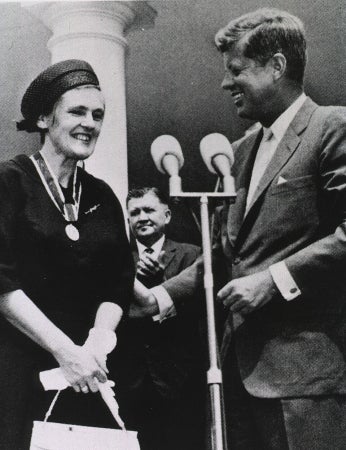
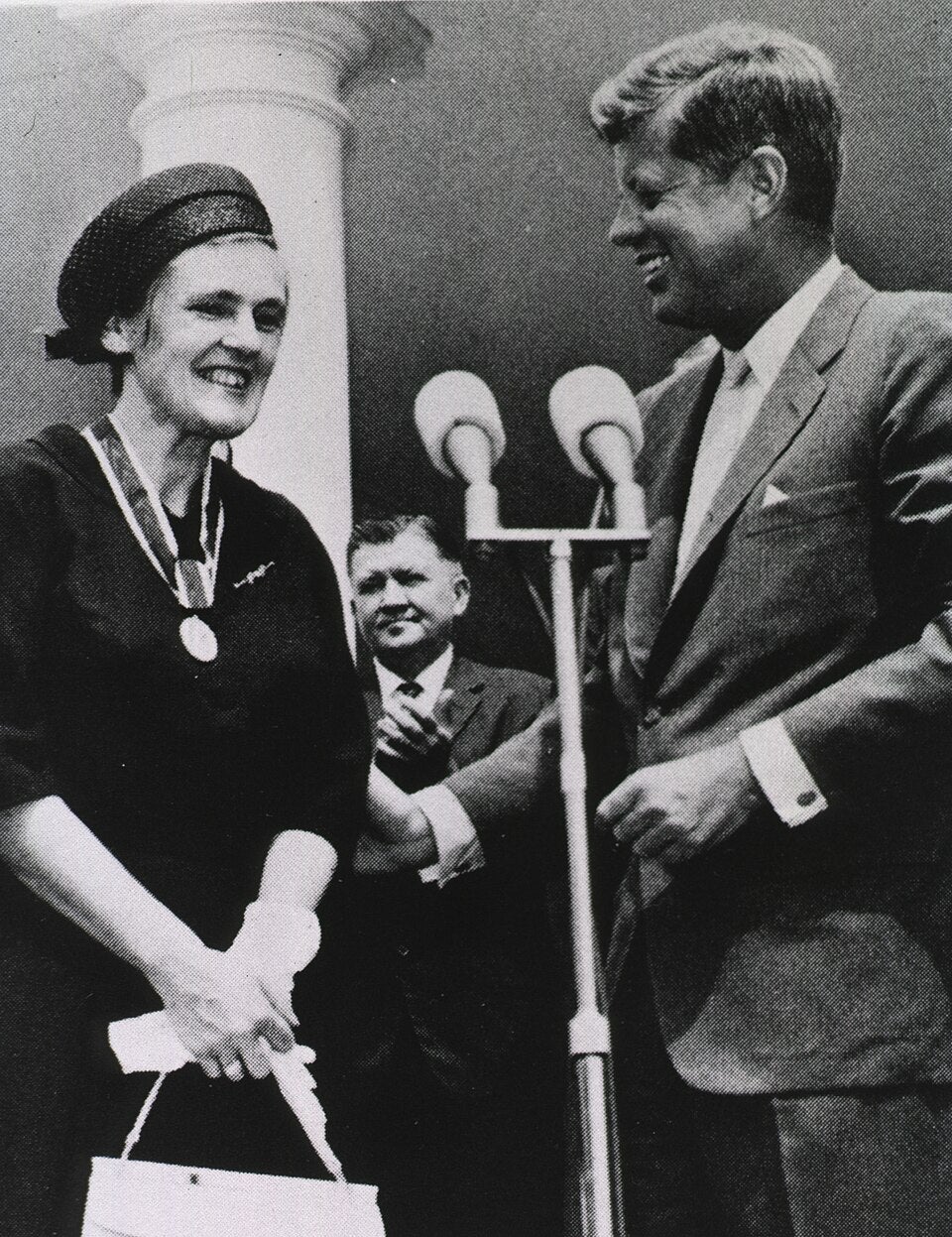
A 1962 Washington Post profile credited Dr. Kelsey's "stubborness and skepticism" for preventing "what could have been an appalling American tragedy." 36 That same year, when President Kennedy awarded her the Medal for Distinguished Federal Civilian Service, he said: “Through high ability and steadfast confidence in her professional decision, she has made an outstanding contribution to the protection of the health of the American people.” 37
Characteristically humble, Kelsey always said she accepted the medal on behalf of many federal employees. “I was very much a last minute addition,” she wrote of the ceremony. She was amused by the astronauts also receiving medals and the fuss made over her: “This really was a team effort.”
Dr. Kelsey continued to work at the FDA until she was 90 years old, serving under ten presidents and witnessing the agency name two awards after her. She was responsible for organizing the FDA’s Investigational New Drug branch, which processed many HIV drugs in the 1980s. In 2014, she left Washington, D.C. to live with her daughter in Ontario. Living to 101, she always considered herself a small part of the thalidomide scandal, the FDA, and the field of science.
Reflecting on a summary of her career, she said: “It has been an interesting” one. 38
Footnotes
- 1
Geraghty, Karen. “Protecting the Public: Profile of Dr. Frances Oldham Kelsey.” AMA Journal of Ethics 3, no. 7 (2001): 252 - 254. https://doi.org/10.1001/virtualmentor.2001.3.7.prol1-0107.
- 2
Geraghty, Karen. “Protecting the Public: Profile of Dr. Frances Oldham Kelsey.” AMA Journal of Ethics 3, no. 7 (2001): 252 - 254. https://doi.org/10.1001/virtualmentor.2001.3.7.prol1-0107.
- 3
Frances Oldham Kelsey, “Autobiographical Reflections,” FDA, n.d., 49, https://www.fda.gov/media/89162/download.
- 4
Seidman, Lisa A., and Noreen Warren. “Frances Kelsey & Thalidomide in the US: A Case Study Relating to Pharmaceutical Regulations.” The American Biology Teacher 64, no. 7 (2002): 495 - 500. https://www.jstor.org/stable/26521817
- 5
Seidman, Lisa A., and Noreen Warren. “Frances Kelsey & Thalidomide in the US: A Case Study Relating to Pharmaceutical Regulations.” The American Biology Teacher 64, no. 7 (2002): 495 - 500. https://www.jstor.org/stable/26521817
- 6
Erick, Miriam. “Frances Kathleen Oldham Kelsey.” National Women’s History Museum, 2023. https://www.womenshistory.org/education-resources/biographies/frances-kathleen-oldham-kelsey.
- 7
Wilson, Todd Allen. “Frances Oldham Kelsey Leaves Legacy As FDA Regulatory Pioneer.” InsideHealthPolicy.Com’s FDA Week 21, no. 32 (2015): 3 - 4. https://doi.org/10.2307/26700027.
- 8
Frances Oldham Kelsey, “Autobiographical Reflections,” FDA, n.d., 50, https://www.fda.gov/media/89162/download.
- 9
Mintz, Morton. “'Heroine of FDA Keeps Bad Drug Off of Market".” The Washington Post, July 15, 1962. https://s3.amazonaws.com/s3.documentcloud.org/documents/2206185/archives-heroine-of-fda-keeps-bad-drug-off-the.pdf.
- 10
Oldham Kelsey, Frances. 52.
- 11
Seidman, Lisa A., and Noreen Warren. “Frances Kelsey & Thalidomide in the US: A Case Study Relating to Pharmaceutical Regulations.” The American Biology Teacher 64, no. 7 (2002): 495 - 500. https://www.jstor.org/stable/26521817
- 12
As a graduate student, Kelsey was one of many clinical researchers working on the drug that caused this scandal, elixir sulfanilamide. It demonstrated to her the need for greater regulation of the pharmaceutical industry. See: Seidman, Lisa A., and Noreen Warren.
- 13
Bren, Linda (March–April 2001), "Frances Oldham Kelsey: FDA Medical Reviewer Leaves Her Mark on History", FDA Consumer, 35 (2): 24–29.
- 14
Oldham Kelsey, Frances. 54.
- 15
Mintz, Morton. “'Heroine of FDA Keeps Bad Drug Off of Market".” The Washington Post, July 15, 1962. https://s3.amazonaws.com/s3.documentcloud.org/documents/2206185/archives-heroine-of-fda-keeps-bad-drug-off-the.pdf.
- 16
Oldham Kelsey, Frances. 55.
- 17
Oldham Kelsey, Frances. 57.
- 18
Oldham Kelsey, Frances. 58.
- 19
Geraghty, Karen. “Protecting the Public: Profile of Dr. Frances Oldham Kelsey.” AMA Journal of Ethics 3, no. 7 (2001): 252 - 254. https://doi.org/10.1001/virtualmentor.2001.3.7.prol1-0107.
- 20
Frances Oldham Kelsey and the Battle Against Thalidomide. 42:15. October 23, 2024. Library of Congress. https://www.loc.gov/item/video-10422/.
- 21
Oldham Kelsey, Frances. 60.
- 22
Oldham Kelsey, Frances. 62.
- 23
Mintz, Morton. “'Heroine of FDA Keeps Bad Drug Off of Market".” The Washington Post, July 15, 1962. https://s3.amazonaws.com/s3.documentcloud.org/documents/2206185/archives-heroine-of-fda-keeps-bad-drug-off-the.pdf. See also Seidman, Lisa A., and Noreen Warren. “Frances Kelsey & Thalidomide in the US: A Case Study Relating to Pharmaceutical Regulations.” The American Biology Teacher 64, no. 7 (2002): 495 - 500. https://doi.org/10.2307/4451354.
- 24
Kermode-Scott, Barbara. “Frances Kathleen Oldham Kelsey.” BMJ: British Medical Journal 351 (2015). https://www.jstor.org/stable/26521817
- 25
Seidman, Lisa A., and Noreen Warren. “Frances Kelsey & Thalidomide in the US: A Case Study Relating to Pharmaceutical Regulations.” The American Biology Teacher 64, no. 7 (2002): 495 - 500. https://www.jstor.org/stable/26521817
- 26
Oldham Kelsey, Frances. 64.
- 27
Mintz, Morton. “'Heroine of FDA Keeps Bad Drug Off of Market".” The Washington Post, July 15, 1962. https://s3.amazonaws.com/s3.documentcloud.org/documents/2206185/archives-heroine-of-fda-keeps-bad-drug-off-the.pdf.
- 28
Mintz, Morton. “'Heroine of FDA Keeps Bad Drug Off of Market".” The Washington Post, July 15, 1962. https://s3.amazonaws.com/s3.documentcloud.org/documents/2206185/archives-heroine-of-fda-keeps-bad-drug-off-the.pdf.
- 29
Oldham Kelsey, Frances. 65.
- 30
Oldham Kelsey, Frances. 65.
- 31
Oldham Kelsey, Frances. 69. For Dr. Taussig's original reports, see her paper: Taussig, H.B. THALIDOMIDE AND PHOCOMELIA. Pediatrics (1962) 30 (4): 654–659. https://doi.org/10.1542/peds.30.4.654
- 32
Geraghty, Karen. “Protecting the Public: Profile of Dr. Frances Oldham Kelsey.” AMA Journal of Ethics 3, no. 7 (2001): 252 - 254. https://doi.org/10.1001/virtualmentor.2001.3.7.prol1-0107.
- 33
Frances Oldham Kelsey and the Battle Against Thalidomide. October 23, 2024. Library of Congress. https://www.loc.gov/item/video-10422/.
- 34
The FDA overcorrected here by generally prohibiting women of child-bearing age from most clinical studies. While this rule was intended to protect women and their babies, it actually compromised women’s health research by sharply limiting their ability to participate in studies. The amount and quality of information about diseases and treatments for women today is still hampered by decades of exclusion from this rule.
- 35
Oldham Kelsey, Frances. 77.
- 36
Mintz, Morton. “'Heroine of FDA Keeps Bad Drug Off of Market".” The Washington Post, July 15, 1962. https://s3.amazonaws.com/s3.documentcloud.org/documents/2206185/archives-heroine-of-fda-keeps-bad-drug-off-the.pdf.
- 37
Kermode-Scott, Barbara. “Frances Kathleen Oldham Kelsey.” BMJ: British Medical Journal 351 (2015). https://doi.org/10.2307/26521817.
- 38
Oldham Kelsey, Frances. 99.
![Sketch of the mythical fuan by Pearson Scott Foresman. [Source: Wikipedia]](/sites/default/files/styles/crop_320x320/public/2023-10/Goatman_Wikipedia_Faun_2_%28PSF%29.png?h=64a074ff&itok=C9Qh-PE1)