Decades Before Rosa Parks, D.C.'s Barbara Pope Challenged Segregation on Public Transportation
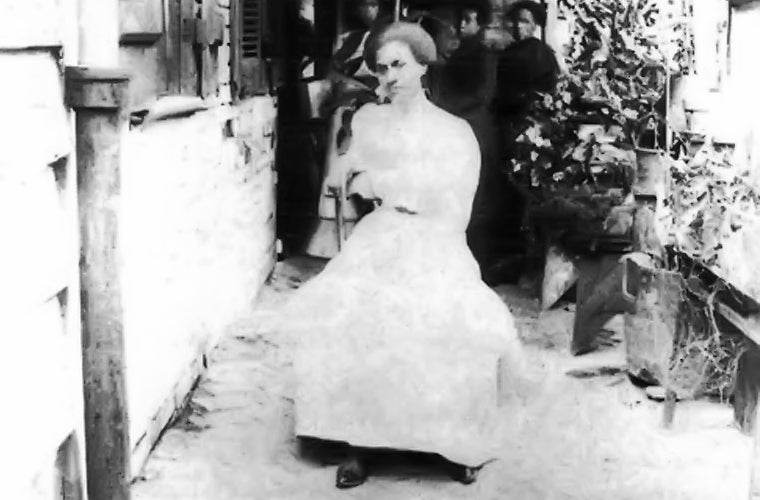
Though Rosa Parks may be the face of peaceful resistance to segregation on public transportation, she was not the first to adopt the strategy. Claudette Colvin, Ellen Harris, Maggie Lena Walker, Ida B. Wells, and Charlotte Brown are just some of the individuals who took a stand against racist policies enacted after the Civil War. 1
In Washington, D.C., one of these civil rights activists whose name has been almost forgotten was Barbara Pope. In 1906, she claimed her right to remain in the first-class seat which she had paid for, rather than be moved to the segregated car.
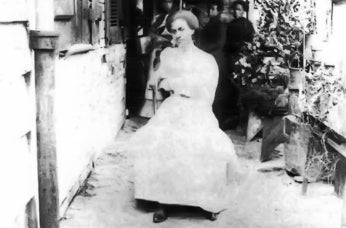
Pope was born in 1854 to Alfred and Hannah Pope, both former slaves. She was the fifth of ten children and lived in Georgetown.
The Pope family had a history of battling the odds for a better life. Her grandmother, enslaved by a relation of Martha Washington, was often punished for sneaking off to dances in Georgetown. 2 Her father, Alfred, was one of 76 slaves who attempted to escape to freedom in the Pearl Affair of 1848.
After being freed in 1850 upon the death of his enslaver, Alfred began a small sanitation business and earned enough to buy property for his family. He also became an early trustee for the Colored Schools of Washington and Georgetown, public schools for formerly enslaved Black students. Barbara herself began teaching in those schools at only sixteen.
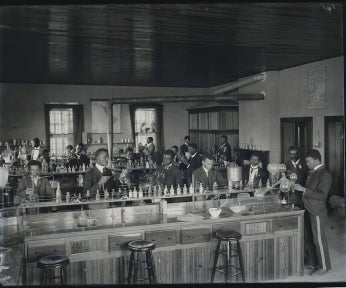
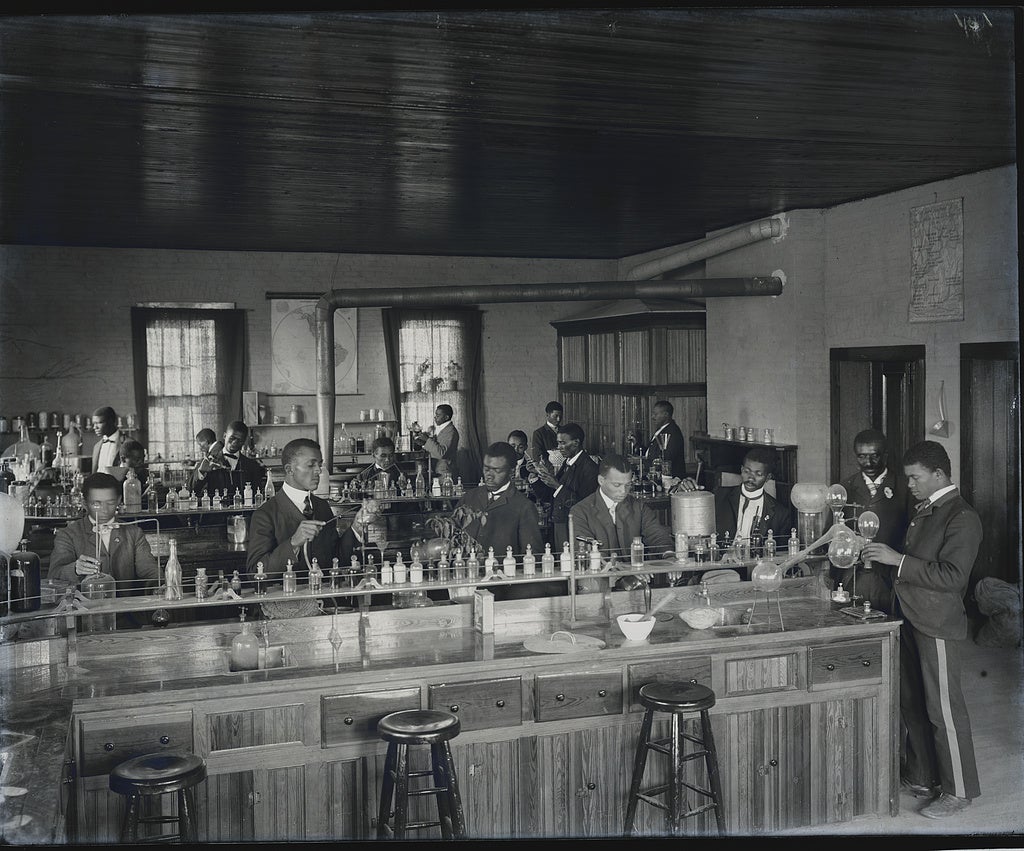
Less than a decade later, Barbara was among the highest-paid teachers in D.C. She taught pupils in the District and had completed a one-year residency at the famous Tuskegee Institute, where she instructed students in Rhetoric, Grammar, and Composition. 3 However, in 1888, she was physically assaulted by a male student in the classroom.
She believed the student deserved expulsion, but administrators allowed him to return “pending an apology.” 4 When the student was readmitted, she vocally condemned the trustees. The Board “characterized [Pope] as unreasonable, misguided, and plagued with suspect judgement” despite the fact that she “had the support of other teachers.” 5 Her father, even though he had connections with the school board, did not intervene on her behalf. Feeling betrayed and humiliated, she quit. It was the end of her teaching career.
At the same time, she was dealt another blow: her fiancée, author and scholar William Hannibal Thomas, “seduced” another woman “into a sham marriage.” Rumor and gossip “circulated through Washington’s close-knit society” after the failed engagement, damaging Pope’s reputation. 6 To avoid the glances and whispers, she retreated from society.
By the time Barbara was an adult, her family was “on the periphery of Washington’s ‘Black 400,’” a community of the nation’s most elite, successful, and powerful African Americans. 7 They were progressive and involved in the community, and like other well-to-do African American families, they vacationed annually for leisure and relaxation.
It was for a rest cure that Barbara boarded a train to Paeonian Springs, Virginia, from Union Station on August 7, 1906.
She had purchased a first-class ticket and had already “sought assurances from the Interstate Commerce Commission” that she would be exempt from a Virginia state law mandating segregated train cars. 8
The so-called “Jim Crow car” on the train was “cramped, with some seats facing backwards.” The two men already seated in the car made Pope uncomfortable; she described them as “rough” and did not feel safe traveling alone with them. 9
Many women in the early twentieth century “complained of the indignities” of segregated Jim Crow cars. 10 Mary Church Terrell wrote of “privations and potential assaults” that faced women traveling alone in such cars, especially on longer journeys. 11
Barbara Pope made her way to her first-class seat as the train pulled out of Union Station. The ride was uneventful until the train crossed the border into Virginia. Then, the conductor approached and informed her that she would have to move to the segregated car, per Virginia law.
Pope refused.
The conductor asked her again, and she refused once more. Then, he threatened her with arrest and removal from the train.
She showed him her ticket. She had “a right to this seat,” she told him, “And you have no right to ask me to leave it.” 12
Why did Pope choose to take a stand, especially when it might put her, a lone female traveler, in danger? To understand Pope’s mentality, we can look to her career not as a teacher, but as a writer.
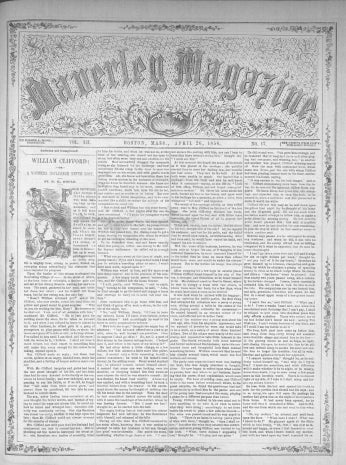
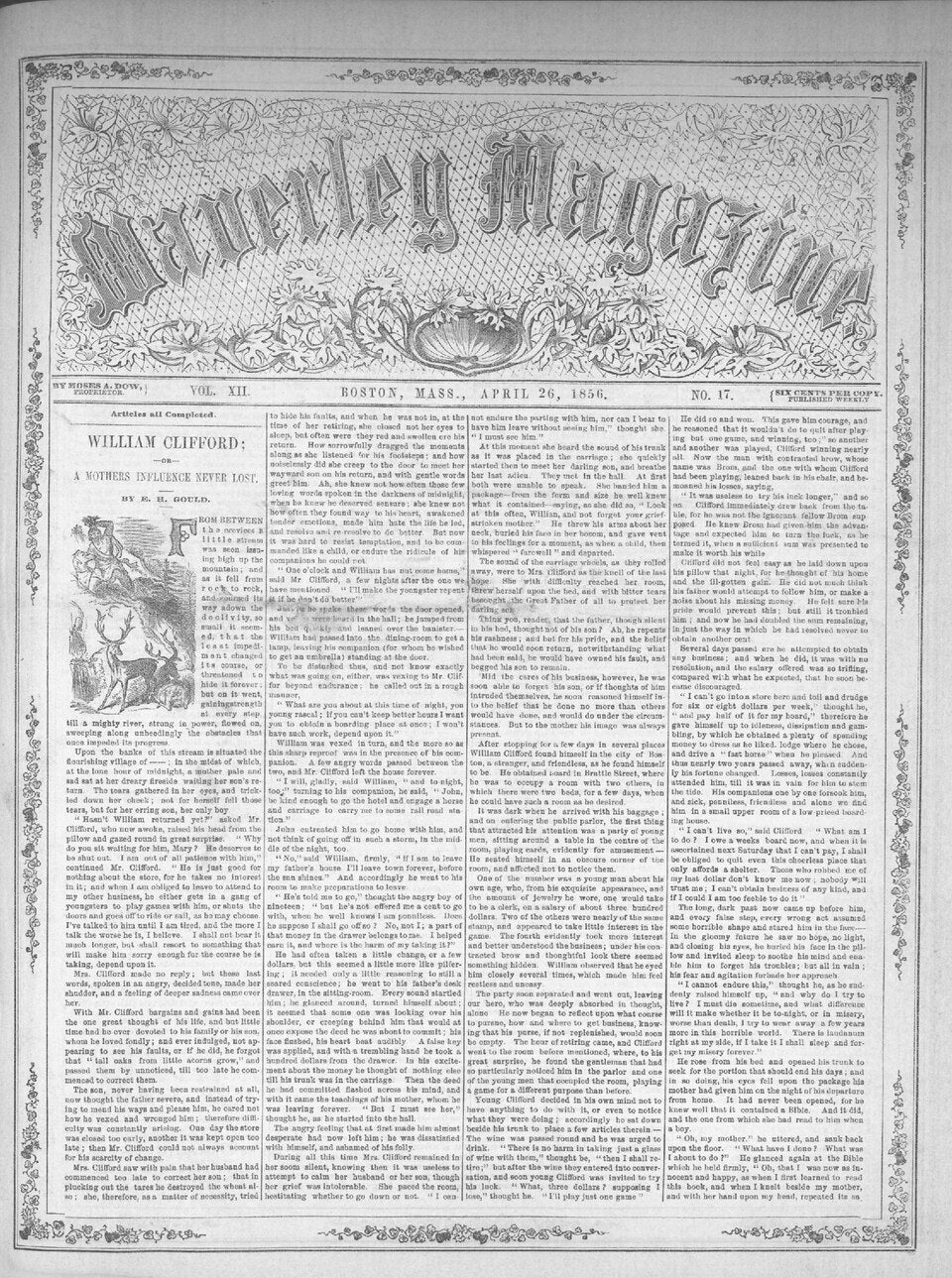
As an early adult, Barbara Pope inhabited a city in an exciting, frightening flux of change and opportunities: Washington was gripped by “hopes not just of emancipation but also of citizenship” while also grappling with the “terror[s]” exposed in “Congressional hearings on the vicious violence against the recently freed African Americans in the South.” 13 The major political divide among African American communities was between followers of Booker T. Washington, who urged education and entrepreneurship over direct challenges to Jim Crow segregation, and W.E.B. Du Bois, who insisted on full civil rights and increased political participation.
Pope’s civic and moral consciousness was heavily shaped by this environment and by her preference for Du Bois’ political philosophy. Perhaps to make sense of the uncertainties surrounding her and her frustrations as a Black woman in a society that stifled her, around the time she resigned from teaching in the 1880s, she began to write fiction.
Historians have uncovered six of her short stories. Like other writers of “postbellum, pre-Harlem Black literature,” she wrote about race, racism, difficulties around higher education and social success, and the pressures of racial “accommodation.” 14 Her story The New Woman addressed the “limited opportunities for women and the patronizing attitudes of men when faced with female competence.” 15 The story Cornelia was about prejudices against female learning. Her stories were even exhibited at the 1900 World’s Fair in Paris, a groundbreaking exhibition organized by W.E.B. Du Bois “present[ing] Black Americans in their own words and images.” 16
Alongside African American literary titans like Frederick Douglass and Sojourner Truth, Barbara Pope gave voice to the experiences of Black women in America, exploring the pressures, expectations, and conflicts facing those in her social class.
When Pope asserted her right to travel in her first-class seat, she was acting on a political and moral philosophy of equality and opportunity that she had developed in her writing. She was also “asserting her right to safe travel,” given the conditions of the Jim Crow car. 17
Unfortunately, the conductor was not of the same opinion. He threatened to have her arrested and ejected from the train.
Pope responded calmly that if he were going to do so, he should please let her off quickly, before they got any further from D.C. She even suggested he remove her at the upcoming stop of Nauck, which she had visited before and where there was a large Black community. But the conductor instead waited until the train had reached Falls Church, which “had a reputation as a segregationist stronghold.” 18
There, two policemen boarded the train, “grabbed Pope by the arms,” and detained her in the mayor’s office. 19
Shaken, Pope posted her bond but was not allowed to leave. She was held until the original train returned, at which point she was taken to the station, where the conductor stopped just long enough to testify against her in a hasty “kangaroo court.” 20 Pope was convicted of violating Virginia’s separate car law, and fined $12 total—more than $400 today.
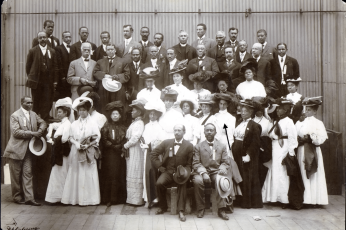
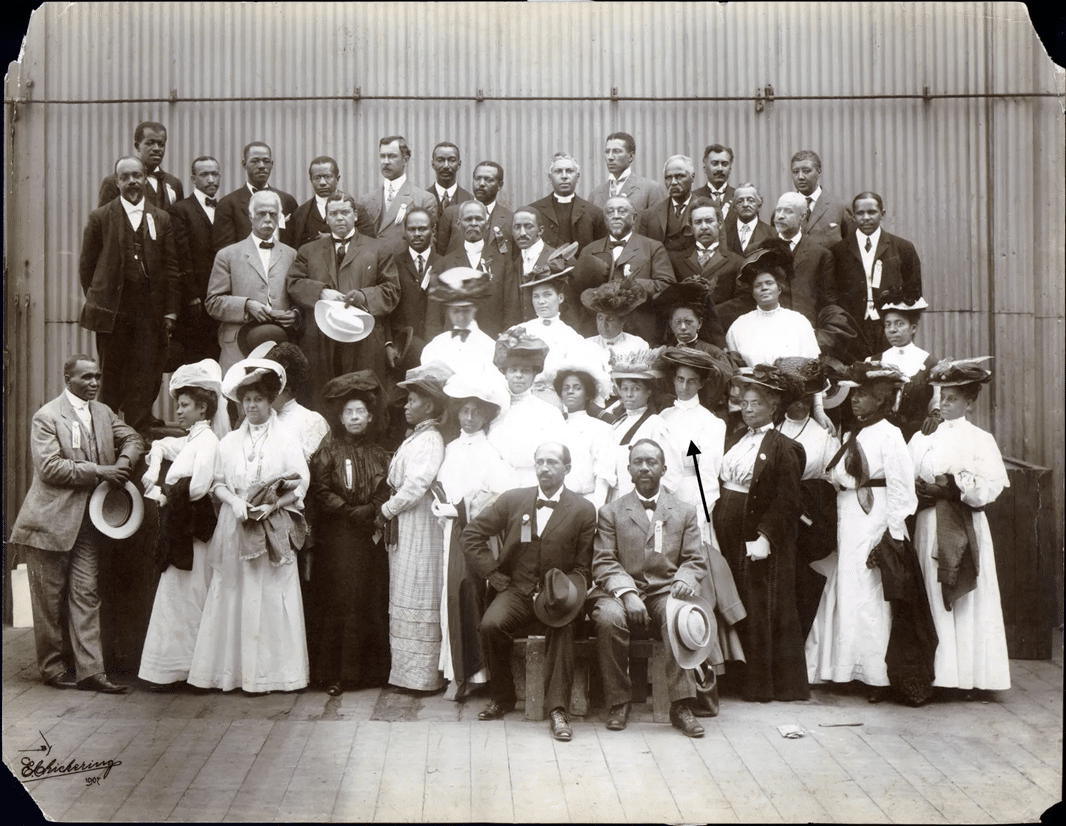
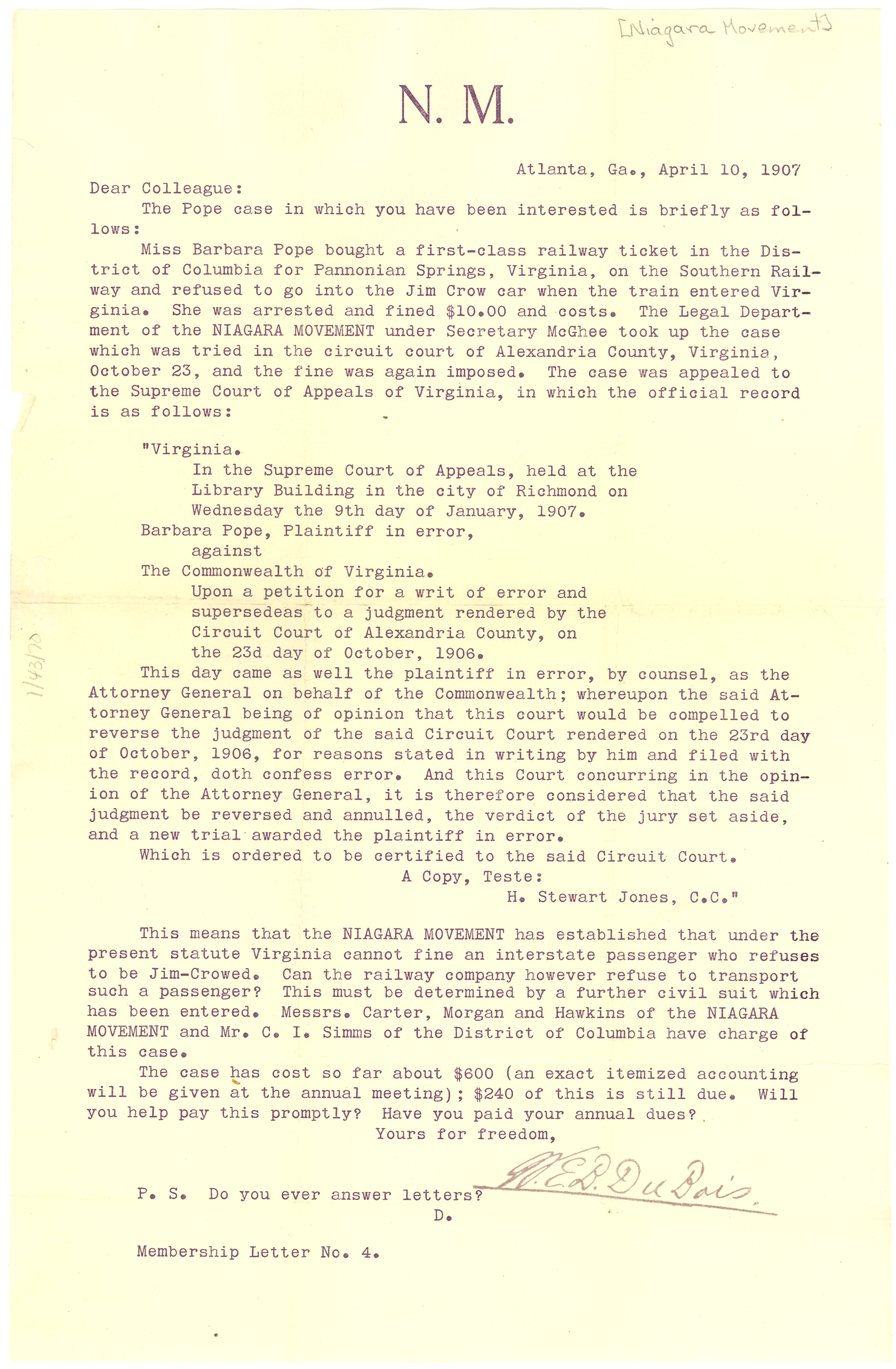
Two weeks after this incident, the Niagara Movement held its annual meeting in Harpers Ferry, Virginia. Led by William Monroe Trotter and W.E.B. Du Bois, the civil rights organization and predecessor of the NAACP was beginning to embrace women’s participation in the movement. Pope herself was one of the first female members.
At the Harpers Ferry meeting, the Movement discussed Pope’s case and voted to support her appeal. At the time, using the legal system to resist segregation was still a novel strategy: even Du Bois was skeptical of putting African Americans “in the hands of Southern courts.” 21
Still, the appeal went forward. The Virginia Circuit Court declined to overturn the conviction, so the Movement pushed on to the state Supreme Court. There, the Virginia attorney general did something surprising: he claimed Pope had been erroneously charged and dropped the case. To contemporary Black observers, the reason for the sudden retreat was obvious: Virginia wanted to avoid legal scrutiny on “the validity of the separate car law.” 22
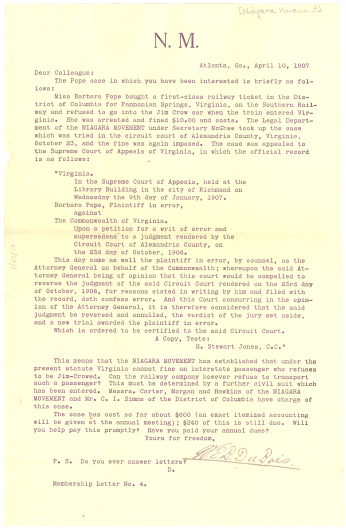
Off the heels of this victory, Pope and the Niagara Movement filed in the D.C. courts, seeking damages of at least $10,000 against the Southern Railway Company, who had operated the train and employed the conductor who had ejected her.
During the trial, the railroad’s lawyers “portrayed the conductor as a man doing his job and Pope as an unreasonable passenger. The judge showed little sympathy for Pope and gave the jury instructions for determining its verdict that tilted in favor of the railroad.” 23 The jury deliberated only a short while before returning with the verdict: the Southern Railway Company had unlawfully removed Pope from the train. They awarded her a single cent in compensation.
Even though “the damages [were] insignificant,” the Niagara Movement claimed “a signal victory” because the court ruled that “the Virginia separate car law [did] not apply to interstate passengers.” 24
But for Pope, that victory was short-lived. Her family deeply disapproved of the publicity and impoliteness of the trial, and criticized her relentlessly for pursuing it. She found no respite in friends or her community. The pathetic damages awarded by the court signified that neither the jury nor the legal system “recognize[d] her as a lady, and… did not recognize her rights… Her career was over, her reputation was damaged, and it led to so much pressure on her.” 25 She began to suffer from insomnia, and lost her job.
On September 5, 1908, she was found hanging from a tree in a public park, with a note pinned to her dress. Addressed to the coroner, she identified herself and said she had chosen suicide because she had not slept in months. It felt like her “brain was on fire.” 26
“This is a war,” Pope’s great-grandniece, Ann Chinn, told PBS in 2023. “This breaking down of white supremacy and segregation—it takes a toll. And it takes a toll on all the individuals who are fighting that who are challenging all that injustice.” 27
The toll it asked of Barbara Pope was not only her life, but her legacy. Because it was considered “impolite” to discuss those who died by suicide, Pope’s bravery, and her civic and literary contributions, were largely forgotten. 28
But her case remained integral to the history of the Civil Rights movement. Despite almost bankrupting itself for Pope’s legal representation, the Niagara Movement recognized how important the courts could be in overturning racist legislation. This strategy would underpin the rest of the Civil Rights movement: the Pope case was “one of the first steps along the path to the end of legal segregation,” culminating in the decision in Brown v Board of Education in 1954. 29
Pope would not live to see the maturation of the Niagara Movement or the Civil Rights era. But she would have heartened to know that she played a part, however small, in the path to ending the inequality and prejudices she explored in her fiction.
As Pope wrote: “Can we not arouse ourselves and manage by some means to cast off this yoke of oppression? Where there is a will, there is a way.” 30
Footnotes
- 1
Davidson, Josh. “Transportation Protests: 1841 to 1992 — Civil Rights Teaching.” Civil Rights Teaching, June 30, 2023. https://www.civilrightsteaching.org/resource/transportation-protests-timeline.
- 2
DeHart, Rob. “Barbara Pope Was a Civil Rights Activist Who Refused to Give Up Her Seat on a Segregated Train.” Teen Vogue, February 3, 2025. https://www.teenvogue.com/story/barbara-pope-civil-rights-activist-seat-train.
- 3
Jennifer Harris. “Barbara E. Pope (1854–1908).” Legacy 32, no. 2 (2015): 281–97. https://doi.org/10.5250/legacy.32.2.0281.
- 4
DeHart, Rob. “Barbara Pope Was a Civil Rights Activist Who Refused to Give Up Her Seat on a Segregated Train.” Teen Vogue, February 3, 2025. https://www.teenvogue.com/story/barbara-pope-civil-rights-activist-seat-train.
- 5
Jennifer Harris. “Barbara E. Pope (1854–1908).” Legacy 32, no. 2 (2015): 281–97. https://doi.org/10.5250/legacy.32.2.0281.
- 6
Jennifer Harris. “Barbara E. Pope (1854–1908).” Legacy 32, no. 2 (2015): 281–97. https://doi.org/10.5250/legacy.32.2.0281.
- 7
GARDNER, ERIC. “Two Stories by Barbara E. Pope.” Legacy 37, no. 2 (2020): 263–71. https://www.jstor.org/stable/27013450.
- 8
DeHart, Rob. “Barbara Pope Was a Civil Rights Activist Who Refused to Give Up Her Seat on a Segregated Train.” Teen Vogue, February 3, 2025. https://www.teenvogue.com/story/barbara-pope-civil-rights-activist-seat-train.
- 9
DeHart, Rob. “Barbara Pope Was a Civil Rights Activist Who Refused to Give Up Her Seat on a Segregated Train.” Teen Vogue, February 3, 2025. https://www.teenvogue.com/story/barbara-pope-civil-rights-activist-seat-train.
- 10
Jennifer Harris. “Barbara E. Pope (1854–1908).” Legacy 32, no. 2 (2015): 281–97. https://doi.org/10.5250/legacy.32.2.0281.
- 11
Ibid.
- 12
DeHart, Rob. “Barbara Pope Was a Civil Rights Activist Who Refused to Give Up Her Seat on a Segregated Train.” Teen Vogue, February 3, 2025. https://www.teenvogue.com/story/barbara-pope-civil-rights-activist-seat-train.
- 13
GARDNER, ERIC. “Two Stories by Barbara E. Pope.” Legacy 37, no. 2 (2020): 263–71. https://www.jstor.org/stable/27013450.
- 14
GARDNER, ERIC. “Two Stories by Barbara E. Pope.” Legacy 37, no. 2 (2020): 263–71. https://www.jstor.org/stable/27013450.
- 15
Jennifer Harris. “Barbara E. Pope (1854–1908).” Legacy 32, no. 2 (2015): 281–97. https://doi.org/10.5250/legacy.32.2.0281.
- 16
Taylor, David A. “She Was the Rosa Parks of D.C., but Her Story Was Mostly Forgotten.” The Washington Post, March 31, 2021. http://www.washingtonpost.com/magazine/2021/03/31/barbara-pope-rosa-parks-of-dc/.
- 17
Jennifer Harris. “Barbara E. Pope (1854–1908).” Legacy 32, no. 2 (2015): 281–97. https://doi.org/10.5250/legacy.32.2.0281.
- 18
DeHart, Rob. “Barbara Pope Was a Civil Rights Activist Who Refused to Give Up Her Seat on a Segregated Train.” Teen Vogue, February 3, 2025. https://www.teenvogue.com/story/barbara-pope-civil-rights-activist-seat-train.
- 19
DeHart, Rob. “Barbara Pope Was a Civil Rights Activist Who Refused to Give Up Her Seat on a Segregated Train.” Teen Vogue, February 3, 2025. https://www.teenvogue.com/story/barbara-pope-civil-rights-activist-seat-train.
- 20
Taylor, David A. “She Was the Rosa Parks of D.C., but Her Story Was Mostly Forgotten.” The Washington Post, March 31, 2021. http://www.washingtonpost.com/magazine/2021/03/31/barbara-pope-rosa-parks-of-dc/.
- 21
Taylor, David A. “She Was the Rosa Parks of D.C., but Her Story Was Mostly Forgotten.” The Washington Post, March 31, 2021. http://www.washingtonpost.com/magazine/2021/03/31/barbara-pope-rosa-parks-of-dc/.
- 22
“The Pope Case.” The Washington bee. (Washington, DC), Jun. 22 1907. https://www.loc.gov/item/sn84025891/1907-06-22/ed-1/.
- 23
DeHart, Rob. “Barbara Pope Was a Civil Rights Activist Who Refused to Give Up Her Seat on a Segregated Train.” Teen Vogue, February 3, 2025. https://www.teenvogue.com/story/barbara-pope-civil-rights-activist-seat-train.
- 24
“The Pope Case.” The Washington bee. (Washington, DC), Jun. 22 1907. https://www.loc.gov/item/sn84025891/1907-06-22/ed-1/.
- 25
BTPM - PBS. “The Forgotten Story of Barbara Pope.” PBS, June 13, 2023. https://www.pbslearningmedia.org/resource/forgotten-story-of-barbara-pope-video/the-niagara-movement-the-early-battle-for-civil-rights/.
- 26
DeHart, Rob. “Barbara Pope Was a Civil Rights Activist Who Refused to Give Up Her Seat on a Segregated Train.” Teen Vogue, February 3, 2025. https://www.teenvogue.com/story/barbara-pope-civil-rights-activist-seat-train.
- 27
BTPM - PBS. “The Forgotten Story of Barbara Pope.” PBS, June 13, 2023. https://www.pbslearningmedia.org/resource/forgotten-story-of-barbara-pope-video/the-niagara-movement-the-early-battle-for-civil-rights/.
- 28
Jennifer Harris. “Barbara E. Pope (1854–1908).” Legacy 32, no. 2 (2015): 281–97. https://doi.org/10.5250/legacy.32.2.0281.
- 29
Taylor, David A. “She Was the Rosa Parks of D.C., but Her Story Was Mostly Forgotten.” The Washington Post, March 31, 2021. http://www.washingtonpost.com/magazine/2021/03/31/barbara-pope-rosa-parks-of-dc/.
- 30
GARDNER, ERIC. “Two Stories by Barbara E. Pope.” Legacy 37, no. 2 (2020): 263–71. https://www.jstor.org/stable/27013450.
![Sketch of the mythical fuan by Pearson Scott Foresman. [Source: Wikipedia]](/sites/default/files/styles/crop_320x320/public/2023-10/Goatman_Wikipedia_Faun_2_%28PSF%29.png?h=64a074ff&itok=C9Qh-PE1)